Fiber Laser Cutting
Sheet and plate cutting in mild steel, stainless and aluminium, from 0.5 to 25 mm, quoted from your DXF
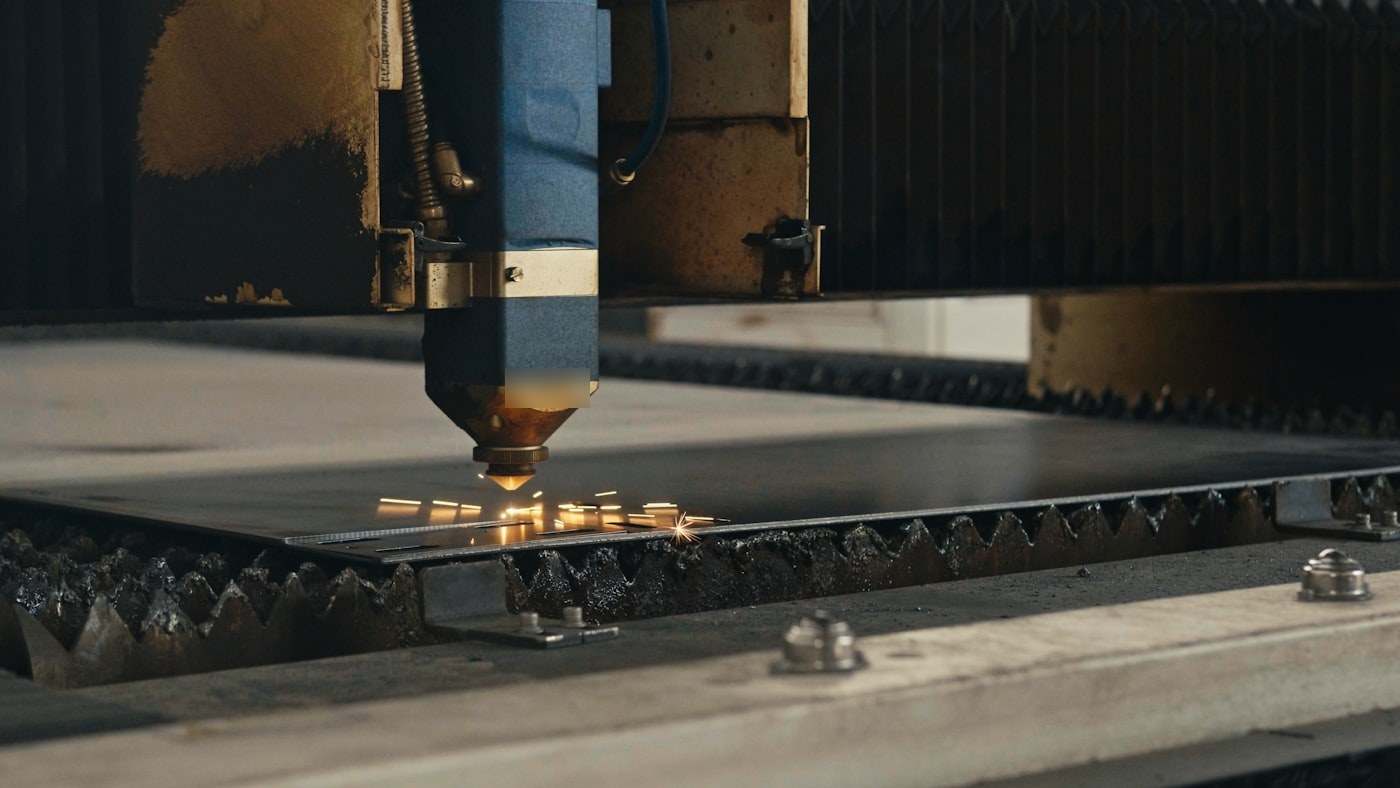
Fiber laser cutting uses a solid-state laser source of 2 to 12 kW delivered through a fibre to a cutting head that melts and blows the metal away with nitrogen or oxygen. It is the standard process for flat parts in mild steel up to 25 mm, stainless steel up to 20 mm and aluminium up to 15 mm, with a kerf of 0.15 to 0.4 mm and a positional tolerance of ±0.1 mm on thin sheet. Upload a DXF or STEP file to CutLinq and receive a binding quote within 12 hours from cutting shops in Egypt, the UAE and Saudi Arabia.
Compared with CO2 lasers, fiber sources cut reflective metals such as aluminium, brass and copper without damaging the resonator, consume roughly a third of the electricity and need no mirror alignment. For contractors in Cairo, Dubai or Riyadh this means shorter queues and lower part prices on thin sheet, where fiber machines run two to three times faster than CO2.
How fiber laser cutting works
A diode-pumped fibre generates a 1.07 µm beam that is focused to a spot of 0.1 to 0.3 mm. The head follows the DXF contour at 2 to 40 m/min depending on thickness. Oxygen assist gas burns mild steel and leaves an oxide edge; nitrogen assist gas melts and ejects material for an oxide-free, paintable and weldable edge. Nitrogen cutting is used for stainless steel, aluminium and any mild steel that will be powder coated.
The machine bed accepts standard sheets of 1500 x 3000 mm and, on larger systems, 2000 x 4000 mm. Parts are nested automatically to fit as many pieces as possible on one sheet, which is why identical parts in batches of 20 to 200 are cheaper per piece than single prototypes.
Thickness range by material
Maximum thickness depends on laser power. The values below are what suppliers in the CutLinq network run in production; the best edge quality is obtained in the middle of each range.
| Material | Grade examples | Typical range | Maximum (6-12 kW) | Assist gas |
|---|---|---|---|---|
| Mild steel | S235JR, S355JR, DC01 | 0.5-20 mm | 25 mm | Oxygen or nitrogen |
| Galvanised steel | DX51D+Z | 0.5-3 mm | 4 mm | Nitrogen |
| Stainless steel | 1.4301 (304), 1.4404 (316L) | 0.5-15 mm | 20 mm | Nitrogen |
| Aluminium | EN AW-5754, 6061-T6, 5052 | 0.5-10 mm | 15 mm | Nitrogen |
| Brass | CuZn37 | 0.5-6 mm | 8 mm | Nitrogen |
| Copper | Cu-ETP | 0.5-5 mm | 6 mm | Nitrogen |
Tolerances and edge quality
Laser cut parts follow ISO 2768-m as a default unless the drawing states otherwise. Kerf width grows with thickness and is compensated in the machine program, so the DXF should be drawn at nominal size. Edge perpendicularity and surface roughness are defined by ISO 9013; a 3 mm stainless part cut with nitrogen typically reaches Ra 3 to 6 µm, while a 20 mm mild steel part cut with oxygen shows Ra 15 to 25 µm and a visible striation angle.
| Thickness | Kerf width | Positional tolerance | Smallest hole | Heat-affected zone |
|---|---|---|---|---|
| 0.5-3 mm | 0.15-0.2 mm | ±0.1 mm | 1 x thickness | 0.05-0.1 mm |
| 4-8 mm | 0.2-0.3 mm | ±0.15 mm | 1.2 x thickness | 0.1-0.2 mm |
| 10-15 mm | 0.3-0.4 mm | ±0.2 mm | 1.5 x thickness | 0.2-0.3 mm |
| 16-25 mm | 0.4-0.6 mm | ±0.3 mm | 2 x thickness | 0.3-0.5 mm |
Fiber laser in MENA conditions
Coastal humidity in Alexandria, Jeddah and Dubai causes flash rust on oxygen-cut mild steel edges within days. Specify nitrogen cutting or a same-week powder coat if the part will be stored outdoors. Sand and dust in the Gulf shorten the life of protective lens windows, so shops typically replace them weekly; this is part of normal cost and does not affect your part quality.
For solar mounting, HVAC and signage contractors in Egypt, Saudi Arabia and the UAE, galvanised DX51D+Z sheet up to 3 mm is the most common laser cut material. Cut edges on galvanised sheet remain bare steel; for exterior use, ask for zinc-rich touch-up or choose hot-dip galvanising after cutting.
Secondary operations after cutting
Most laser cut parts go on to bending, tapping, welding or coating. Ordering these together with the cutting shortens transport and keeps one supplier responsible for the finished part.
- Deburring and edge rounding, typically 0.2-0.5 mm radius on sheet up to 6 mm
- Press brake bending to ±0.5° angle, ±0.2 mm flange length on sheet up to 12 mm
- Tapping M3 to M12 or press-in inserts for sheet 1-4 mm
- Powder coating 60-120 µm in any RAL colour, or hot-dip galvanising 45-85 µm
- TIG or MIG welding of cut parts into frames and enclosures
Design tips
- Keep hole diameters at or above the sheet thickness; a 2 mm hole in 3 mm steel should be drilled instead of laser cut.
- Leave at least 1 x thickness (minimum 1 mm) between a hole edge and the part edge to avoid burn-through.
- Draw slots and tabs at nominal size; kerf compensation of 0.15-0.4 mm is applied by the machine, not by you.
- Add 0.1-0.2 mm clearance to slot widths for press-fit tabs in 1-3 mm sheet to allow for kerf taper.
- Use a single closed polyline per contour, no overlapping lines, no text as outlines unless it is to be cut.
- For parts over 1500 x 3000 mm, split the design at a bolted or welded joint instead of requesting oversize sheet.
- Specify nitrogen cutting on mild steel that will be powder coated; oxide edges reduce coating adhesion.
Applications
| Industry | Example parts | Typical material |
|---|---|---|
| HVAC and ducting | Flanges, damper blades, grille faces | DX51D+Z 0.8-2 mm |
| Solar | Mounting brackets, clamps, cable trays | S235JR 3-6 mm, hot-dip galvanised |
| Signage and architecture | Perforated screens, logo letters, facade panels | 1.4301 (304) 1.5-3 mm, EN AW-5754 2-4 mm |
| Electrical | Enclosure blanks, gland plates, busbar supports | DC01 1.5-2 mm, Cu-ETP 3-5 mm |
| Machinery | Machine guards, base plates, gussets | S355JR 6-20 mm |
| Food equipment | Trays, washdown panels, conveyor side plates | 1.4404 (316L) 2-4 mm |
| Furniture | Table legs, shelving brackets, decorative panels | S235JR 2-4 mm, powder coated |
Pricing and lead time
Three factors set the price of a laser cut part: cutting time (total contour length divided by cutting speed for that thickness and material), sheet material consumed after nesting, and setup plus handling per order. Cutting 6 mm stainless costs roughly 2.5 times more per metre than 2 mm mild steel, and a part with 40 small holes costs more than a plain blank of the same outline because every pierce adds 0.5-2 seconds. Lead time for cut-only parts is 2 to 4 working days in Cairo, Dubai, Riyadh and Jeddah, and 4 to 7 working days with bending, tapping and powder coating added. Small parts are delivered by courier the same or next day inside the city; pallets take 1-2 days.
Frequently asked questions
Mild steel S235JR and S355JR up to 25 mm with oxygen on a 12 kW machine. Above 20 mm, plasma cutting is usually cheaper if ±1 mm tolerance is acceptable.
Upload your DXF or STEP file to CutLinq and receive a binding fiber laser cutting quote within 12 hours.