Thick Steel Plate Cutting (10 to 25 mm)
Fiber laser, plasma and oxy-fuel cutting of S235JR and S355J2 plate for base plates, gussets, flanges and machinery parts
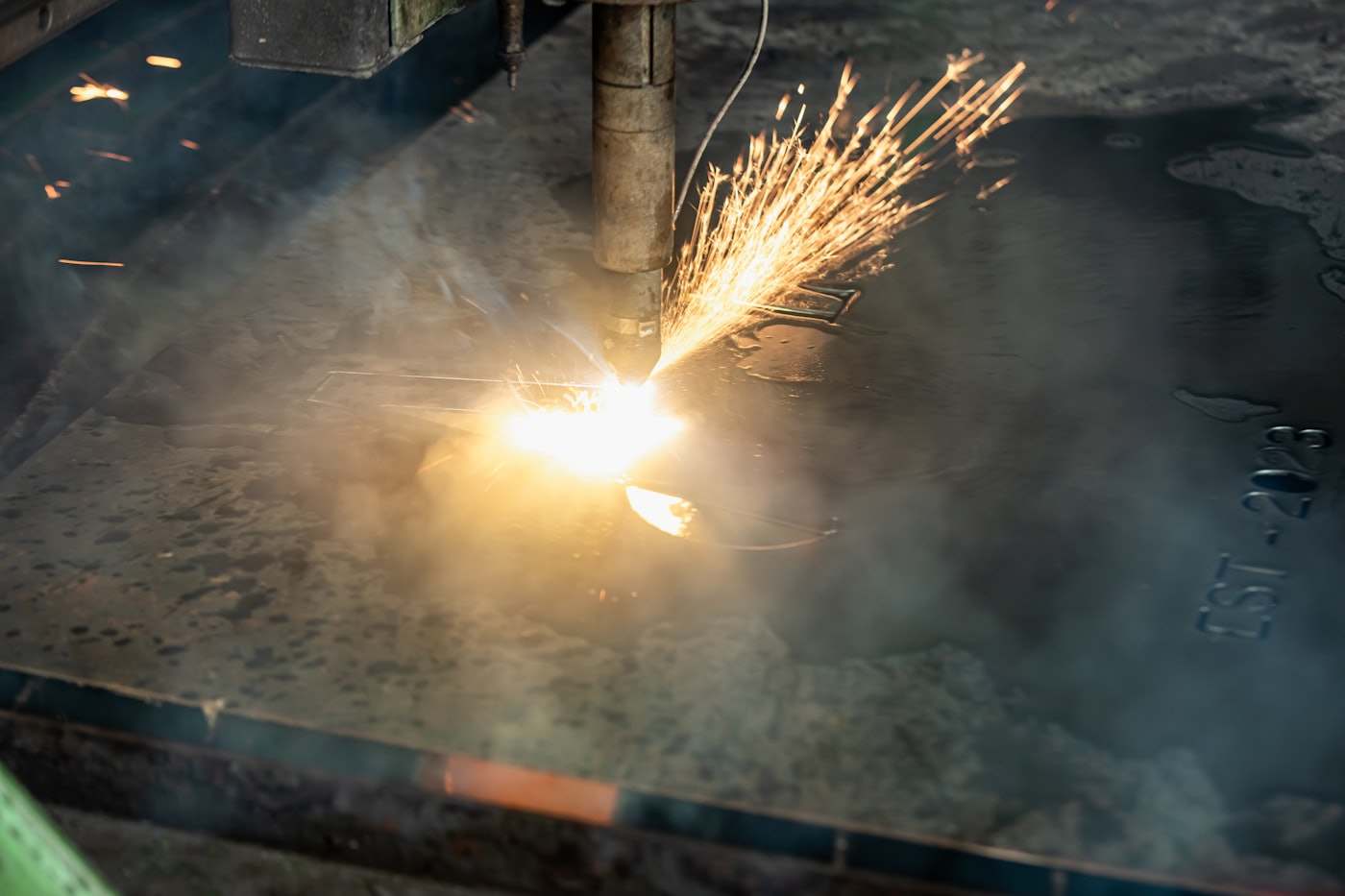
Thick plate cutting covers steel from 10 to 25 mm and beyond, the range where base plates, gussets, lifting lugs, flanges, bucket teeth and crusher liners are made. Three processes compete: fiber laser (best accuracy, to 25 mm), CNC plasma (lowest cost per metre, to 40 mm) and oxy-fuel (to 200 mm). Through CutLinq you can order thick plate parts in S235JR, S355J2, S690QL and wear plate with a tolerance of ±0.2 mm on laser and ±0.5 mm on plasma.
The choice depends on hole size, edge squareness and the finishing you plan next. Upload a DXF file with the plate thickness and grade and receive a binding quote within 12 hours.
Laser, plasma or oxy-fuel: which process for which thickness
A 6-12 kW fiber laser cuts mild steel to 25 mm with oxygen assist gas. The edge is square within 0.5° and holes down to 1 x thickness are round. Above 15 mm, cutting speed drops sharply, so plasma becomes cheaper per metre of cut: a 400 A high-definition plasma cuts 20 mm at 1.5 m/min against 0.7 m/min for laser. Plasma leaves a bevel of 1-3° on one side and cannot cut holes smaller than about 1.5 x thickness without them going oval.
Oxy-fuel is slow but has no thickness limit in practice; it is used for 40 mm and above and for cheap large blanks that will be machined anyway. Waterjet is used for hardened wear plate above 25 mm where heat would soften the edge.
| Process | Thickness range (mild steel) | Tolerance | Edge bevel | Min hole | Relative cost per metre at 20 mm |
|---|---|---|---|---|---|
| Fiber laser 6-12 kW | 10 to 25 mm | ±0.2 mm | under 0.5° | 1 x t | 1.0 |
| HD plasma 260-400 A | 10 to 40 mm | ±0.5 mm | 1 to 3° | 1.5 x t | 0.6 |
| Oxy-fuel | 12 to 200 mm | ±1.0 mm | under 1° | 2 x t | 0.5 |
| Waterjet | 10 to 150 mm | ±0.2 mm | under 0.5° with taper compensation | 1 x t | 3.0 |
Plate grades and availability in the region
S235JR is the default structural plate and is stocked in 10, 12, 15, 20 and 25 mm in Egypt, the UAE and Saudi Arabia. S355J2 costs 10-15% more and is specified for welded structures under load and for anything designed to Eurocode. High-strength S690QL and wear plate at 400 or 500 HB are imported and usually need 2-4 weeks unless the supplier holds stock.
Plate arrives with mill scale. For parts that will be painted or powder coated, ask for shot blasting to Sa 2.5 after cutting; for parts that will be machined, mill scale is removed by the machining anyway.
| Grade | Yield strength | Stock thickness | Typical use | Relative material cost |
|---|---|---|---|---|
| S235JR | 235 MPa | 10-25 mm | base plates, brackets, general fabrication | 1.0 |
| S355J2 | 355 MPa | 10-25 mm | structural connections, lifting lugs, crane parts | 1.1-1.15 |
| S690QL | 690 MPa | 10-20 mm (import) | booms, high-load lugs, mobile equipment | 2.0-2.5 |
| Wear plate 400 HB | 1000 MPa | 10-25 mm (import) | chutes, liners, bucket edges | 2.5-3.0 |
| 1.4301 (304) plate | 210 MPa | 10-20 mm | process equipment, food plant frames | 3.5-4.5 |
Edge quality and heat-affected zone
Laser oxygen cutting of thick plate produces an oxide skin on the edge that must be removed before welding or painting; a wire brush or light grind is enough. The heat-affected zone is 0.3-0.8 mm on 20 mm plate and does not affect S235 or S355. Plasma edges have a hardened layer of 0.5-1.5 mm which can make drilling near the edge difficult; drill holes in the same operation or pre-drill 1 mm undersize.
Dross on the bottom edge is normal on plasma and on laser above 20 mm. Specify dross-free if the part goes straight to assembly; the supplier will grind it off.
- Laser edge roughness: Ra 12-25 µm on 20 mm plate
- Plasma edge roughness: Ra 25-50 µm
- Heat-affected zone: laser 0.3-0.8 mm, plasma 0.5-1.5 mm
- Squareness: laser under 0.2 mm over 20 mm, plasma 0.5-1 mm
- Hole roundness: laser within 0.1 mm, plasma within 0.5 mm
Holes, bevels and machining after cutting
Bolt holes in thick plate are best laser cut to finished size when the hole is at least 1 x thickness and the fit is a clearance fit. For close-fit holes, pin holes and tapped holes, cut 1-2 mm undersize and drill or ream afterwards. Weld preparation bevels of 30° or 45° can be cut on bevel-head plasma machines in one pass, which saves hours of grinding on heavy fabrication.
Flatness of cut plate parts is typically 2-3 mm per metre from mill tolerance; specify levelling if the part is a machine base or mounting plate.
What to send for a thick plate quote
A DXF of the flat part with the thickness and grade, the number of pieces, and a note on which holes need drilling or tapping. Mark bevels with angle and side. State if a mill certificate 3.1 is required; it is standard for structural work in Saudi Arabia and the UAE and easy to supply when requested before cutting.
Design tips
- Keep laser-cut holes at least 1 x plate thickness in diameter; below that, cut a pilot and drill.
- For plasma, keep holes at least 1.5 x thickness and expect ±0.5 mm; specify drilling for anything tighter.
- Leave 2 x thickness between a hole edge and the plate edge on 20 mm plate to avoid blowout.
- Add 1-2 mm machining allowance on faces that will be milled or on close-fit bores.
- Call out weld bevels as angle plus root face, for example 30° with 2 mm root face, and mark the side.
- Specify shot blasting to Sa 2.5 if the part will be painted; scale left under paint fails within a year in Gulf humidity.
- Nest large parts together on one plate size (1500 x 3000 or 2000 x 6000 mm) to reduce remnant cost.
Applications
| Industry | Example parts | Typical material |
|---|---|---|
| Construction steelwork | base plates, end plates, gusset plates, stiffeners | S235JR, S355J2 10-25 mm |
| Cranes and lifting | lifting lugs, padeyes, spreader beam plates | S355J2, S690QL |
| Mining and cement | chute liners, hammer plates, crusher parts | wear plate 400 HB |
| Machinery OEM | machine bases, bearing blocks, press frames | S355J2 20-25 mm |
| Oil and gas | skid frames, pipe supports, blind flanges | S355J2, 1.4404 (316L) |
| Solar and utilities | pile caps, tracker mounting plates | S235JR 10-12 mm |
| Agriculture | plough shares, harrow discs blanks, hitch plates | S355J2, wear plate |
Pricing and lead time
Three factors set the price: plate weight and grade (S355J2 costs 10-15% more than S235JR; wear plate 2.5-3 times), cut length and thickness (laser at 25 mm costs about 4 times per metre what it costs at 10 mm), and quantity, since large plates are nested and the remnant is charged when the order is small. Drilling, bevelling and shot blasting are quoted per part. Realistic lead times are 3 to 5 working days for S235JR and S355J2 from stock, 6 to 10 working days with drilling and blasting, and 3 to 5 weeks when imported grades must be procured.
Frequently asked questions
Fiber lasers of 6 kW and above cut mild steel to 25 mm with oxygen. For 20 mm we quote laser when accuracy matters and plasma when cost matters; the difference is roughly 40% on cutting cost.
Upload your DXF now and receive a binding quote for thick plate cutting within 12 hours.