Mild Steel (S235, S355, DC01)
Grades, thicknesses, cutting and machining data for the most common structural and sheet steel in Egypt, the UAE and Saudi Arabia
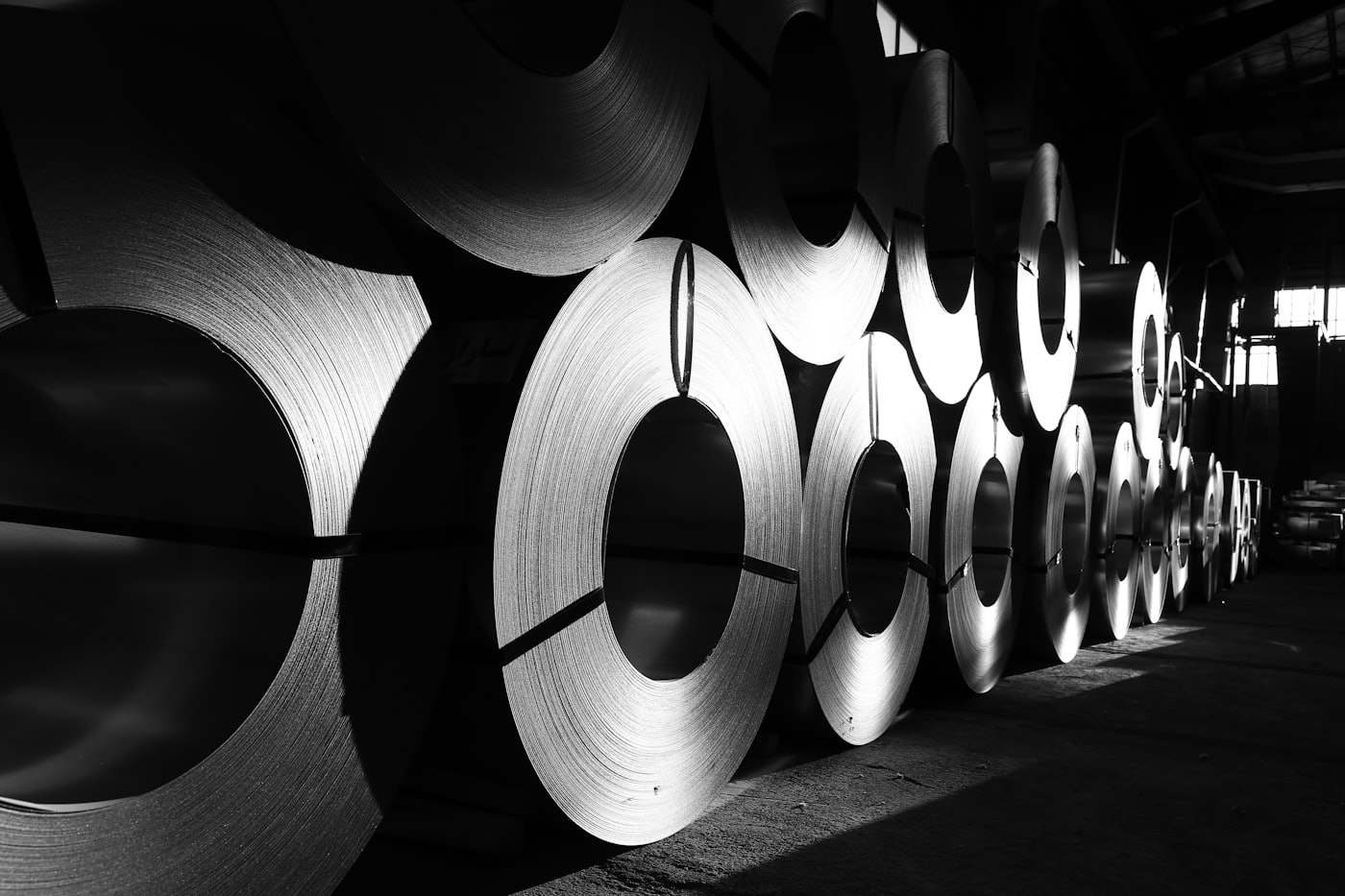
Mild steel is low-carbon steel (0.05-0.25% C) that can be laser cut, bent, welded, machined and painted with no special measures, which is why it is the default material for brackets, frames, enclosures and structural parts. The three grades a buyer in Egypt, the UAE or Saudi Arabia meets most often are S235JR (structural, 235 MPa yield), S355J2 (higher strength, 355 MPa yield) and DC01 (cold-rolled sheet, ex-St12) for thin, clean-surfaced parts. CutLinq cuts, forms and machines all three from stock plate and sheet.
This page lists the grades and their equivalents, the thickness ranges each process handles, the surface conditions you can order, and the corrosion protection needed because bare mild steel rusts within days in coastal humidity.
Grades and equivalents
European EN 10025 and EN 10130 designations are standard on drawings, but local stockists in Cairo, Jebel Ali and Dammam often label material by the old DIN or ASTM name. The table gives the equivalents so you can check a mill certificate.
S355J2 costs roughly 10-15% more than S235JR per kilogram but allows a thinner section for the same load, so it is often cheaper per part in structural work. DC01 is priced per sheet rather than per plate and suits parts under 3 mm that will be visible or powder coated.
| EN grade | Old / ASTM equivalent | Yield (MPa) | Tensile (MPa) | Typical form |
|---|---|---|---|---|
| S235JR (1.0038) | St37-2, A283 Gr C | 235 | 360-510 | Hot-rolled plate 3-100 mm |
| S275JR (1.0044) | St44-2 | 275 | 410-560 | Hot-rolled plate, sections |
| S355J2 (1.0577) | St52-3, A572 Gr 50 | 355 | 470-630 | Hot-rolled plate 6-100 mm |
| DC01 (1.0330) | St12, CR1 | 140-280 | 270-410 | Cold-rolled sheet 0.5-3 mm |
| DC04 (1.0338) | St14, CR4 | 140-210 | 270-350 | Deep-drawing sheet 0.5-2.5 mm |
| S235JR pickled (HRPO) | St37 gebeizt | 235 | 360-510 | Hot-rolled sheet 1.5-6 mm, scale removed |
Thickness ranges by process
Fiber laser cuts mild steel cleanly up to 25 mm with oxygen assist; above 15 mm the edge has a slight taper of 0.1-0.2 mm and a fine oxide skin that must be removed before painting. Plasma takes over from 20 mm to 60 mm at lower edge quality, and waterjet is used when no heat-affected zone is acceptable.
Bending on a press brake is practical to 12 mm for S235JR; S355J2 springs back more and needs a larger die opening. CNC machining handles any thickness, and S235JR machines easily but leaves a slightly smeared finish compared with 42CrMo4 or free-cutting 11SMn30.
| Process | S235JR / S355J2 | DC01 | Typical tolerance |
|---|---|---|---|
| Fiber laser cutting | 1 to 25 mm | 0.5 to 3 mm | ±0.1 mm to 6 mm, ±0.2 mm above |
| CNC plasma cutting | 6 to 60 mm | not used | ±0.5 to ±1.0 mm |
| Waterjet cutting | 1 to 150 mm | 0.5 to 3 mm | ±0.1 to ±0.2 mm |
| Press brake bending | 1 to 12 mm | 0.5 to 3 mm | ±0.5° angle, ±0.2 mm flange |
| CNC milling / turning | any | any | ±0.05 mm standard, ±0.01 mm achievable |
| MIG / TIG welding | 1 to 40 mm | 0.8 to 3 mm | per ISO 5817 level C |
Surface condition: black, pickled or cold-rolled
Hot-rolled S235JR arrives with a blue-grey mill scale. The scale is loosely bonded and will lift paint or powder coat with it, so parts that are to be coated should be ordered as pickled-and-oiled (HRPO) sheet, or shot-blasted to Sa 2.5 after cutting. DC01 cold-rolled sheet has a smooth, scale-free surface with Ra 0.6-1.6 µm and is the right choice for enclosures, panels and anything that will be seen.
Laser-cut edges on oxygen-assisted steel carry a thin oxide film; if the part will be powder coated, ask for nitrogen cutting up to 8 mm or a light edge blast so the coating adheres at the edge.
Corrosion protection in MENA conditions
Uncoated mild steel shows surface rust within 24-48 hours in Alexandria, Jeddah or Dubai humidity and within a week in Cairo's dry dust. Every mild steel part that leaves the workshop needs a protection step matched to its exposure.
For indoor parts, a zinc phosphate plus powder coat at 60-80 µm is sufficient. For exterior parts near the coast, hot-dip galvanising to ISO 1461 (45-85 µm depending on thickness) or galvanising plus powder coat (duplex) gives 15-25 years. Zinc electroplating at 5-12 µm is a shop-handling protection only and is not suitable for exterior Gulf exposure.
- Indoor, dry: powder coat 60-80 µm on phosphated surface
- Indoor, humid or washdown: zinc plate 8-12 µm plus powder coat, or 304 stainless instead
- Exterior inland (Riyadh, 10th of Ramadan): powder coat 80-120 µm on blasted surface, or hot-dip galvanising
- Exterior coastal (Jeddah, Alexandria, Abu Dhabi): hot-dip galvanising 70-85 µm, duplex for colour
- Buried or immersed: hot-dip galvanising plus bituminous or epoxy coating 250 µm
Welding and machining notes
S235JR and S355J2 weld with standard ER70S-6 (G3Si1) wire without preheat up to 25 mm. Above 25 mm on S355J2, or in the cold winter nights of the Saudi interior, preheat to 75-100 °C to avoid hydrogen cracking. DC01 sheet below 1 mm is best joined by TIG or spot welding to limit distortion.
For machined parts under load, 42CrMo4 or C45 is a better choice than S235; mild steel is used for machined parts only where cost dominates and stress is low, such as spacers, base plates and jigs.
Design tips
- Specify the grade and surface: S235JR HRPO for coated parts, DC01 for visible sheet under 3 mm.
- Keep laser-cut holes at least 1x material thickness in diameter; below that, drill after cutting.
- Use inside bend radius equal to thickness for S235JR and 1.5x thickness for S355J2 to avoid cracking.
- Minimum flange length after bending: 4x thickness plus bend radius, for example 20 mm on 4 mm plate.
- Add 2-3 mm clearance in slots that receive galvanised parts; the zinc layer adds 70-85 µm per surface.
- For welded frames, design in 2-3 mm gaps rather than zero-gap butt joints so parts fit after laser cutting.
- State the corrosion protection on the drawing; bare mild steel is delivered oiled only.
Applications
| Industry | Example parts | Typical material |
|---|---|---|
| Construction and steelwork | Base plates, gussets, cleats, stair stringers | S235JR, S355J2 6-25 mm |
| HVAC and building services | Support brackets, hangers, plenum frames | S235JR 3-6 mm, DC01 |
| Solar mounting | Purlin clamps, foundation plates, ballast trays | S235JR galvanised, S355J2 |
| Machinery and OEM | Machine bases, guards, weldment frames | S235JR, S355J2 |
| Electrical enclosures | Panel bodies, doors, gland plates | DC01 1.5-2 mm powder coated |
| Furniture and fit-out | Table frames, shelving, display stands | DC01, S235JR 2-4 mm |
| Automotive workshops | Jigs, trailer parts, ramps | S355J2 4-10 mm |
Pricing and lead time
Price of a mild steel part is driven by material weight and plate thickness (a 10 mm part costs more per cm² to cut than 3 mm because cutting speed drops from about 4 m/min to 1 m/min), by cut length and number of pierces (a perforated panel with 400 holes costs more than a plain bracket of the same size), and by the finishing step (galvanising or powder coating can equal or exceed the cutting cost on small parts). Laser-cut parts without finishing are typically ready in 2-4 working days; with bending and powder coating 5-8 working days; hot-dip galvanised structural parts 7-12 working days across Egypt, the UAE and Saudi Arabia.
Frequently asked questions
S355J2 lets you use 4 mm instead of 5 mm for the same load, saving weight and galvanising cost. If the design is already sized for S235JR, keep it; changing grade without recalculation is not worth it.
Upload your DXF or STEP file with the steel grade and finish, and receive a binding quote within 12 hours.