Stainless Steel TIG Welding
TIG welded 304 and 316L frames, tanks, kitchen equipment and railings with back purging, pickling and passivation
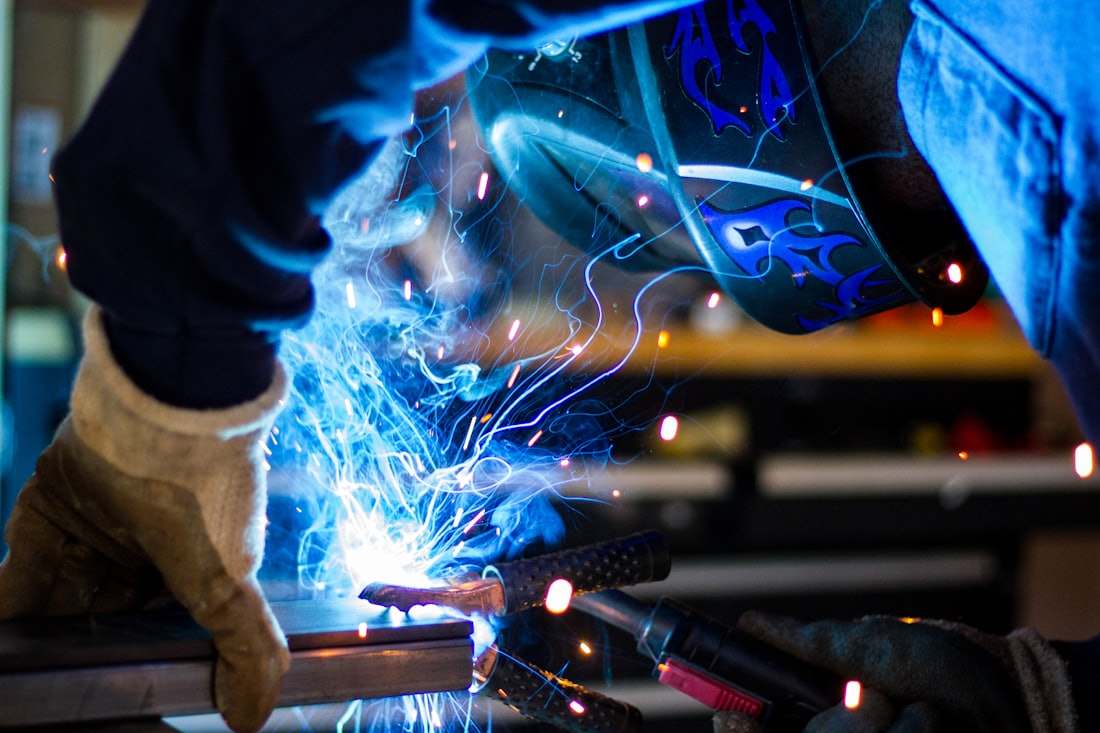
Stainless steel TIG welding (GTAW) joins 1.4301 (304) and 1.4404 (316L) with a tungsten electrode under argon shielding, producing clean, low-spatter welds from 0.8 mm sheet to about 6 mm in a single pass and 12 mm with multiple passes. It is the process for visible welds, food-contact surfaces, thin-wall tube and anything that must keep its corrosion resistance. CutLinq suppliers in Egypt, the UAE and Saudi Arabia weld to ISO 5817 level C or B; upload a STEP file or drawing and receive a binding quote within 12 hours.
Stainless conducts heat only a quarter as well as mild steel and expands 50% more, so it warps easily and needs clamping, tack sequencing and low heat input. The weld must also be protected on the back side with argon purging and cleaned afterwards; a weld that is left with heat tint will rust in Gulf coastal air within a season.
TIG, MIG or laser welding for stainless
TIG gives the best control and appearance and is standard below 3 mm and for all visible or hygienic welds. Pulsed MIG (GMAW) is 3 to 5 times faster on 3 to 12 mm structural work such as tank shells and skids, with a slightly rougher bead. Laser welding is used for thin decorative panels where distortion must be near zero. Most stainless jobs in the region are quoted as TIG unless the buyer asks otherwise.
| Process | Thickness | Speed | Appearance | Typical use |
|---|---|---|---|---|
| TIG (GTAW) | 0.5-6 mm single pass, 12 mm multi | 10-25 cm/min | Smooth, uniform ripple | Kitchens, railings, tube, sanitary |
| Pulsed MIG (GMAW) | 1.5-15 mm | 30-60 cm/min | Slight spatter, wider bead | Tanks, skids, frames |
| Laser welding | 0.5-3 mm | 100-300 cm/min | Narrow seam, minimal distortion | Panels, enclosures, decorative |
| Spot welding | 0.5-3 mm | 1 spot per second | Small indents | Enclosures, brackets, shelving |
Filler metals and grade matching
The filler must match or exceed the base metal. Welding 316L with 308L filler reduces corrosion resistance at the joint; welding 304 with 316L filler is acceptable and common when only one wire is stocked. Dissimilar joints between stainless and mild steel use 309L.
| Base metal | Filler (ISO / AWS) | Shielding gas | Notes |
|---|---|---|---|
| 1.4301 (304), 1.4307 (304L) | ER308L / 19 9 L | Argon 99.99% | Standard for kitchens and architecture |
| 1.4404 (316L) | ER316L / 19 12 3 L | Argon 99.99% | Coastal, chemical, marine |
| 1.4462 (2205) duplex | ER2209 / 22 9 3 N L | Argon + 2% N2 | Desalination, oil and gas, controlled interpass |
| Stainless to S235JR | ER309L / 23 12 L | Argon | Transition joints, brackets |
| 1.4541 (321) | ER347 / 19 9 Nb | Argon | Heat resisting, exhaust |
Distortion, heat input and purging
A 1.5 mm stainless sheet 1 m long shrinks about 1 mm along a full-length weld and pulls the assembly out of square if welded in one pass. Suppliers control this by tacking every 50-100 mm, welding in short alternating segments, using copper backing bars as heat sinks, and keeping interpass temperature below 150°C. Expect ±1 mm over 1 m and ±0.5° on welded frames unless the drawing calls for post-weld machining.
Every tube and closed vessel weld in 304 or 316L needs argon back purging to prevent sugaring, the black oxide that forms on the root side. Unpurged root welds in pipe for food, water or chemical service will pit and are rejected on inspection. Purging adds 10-20% to the weld cost of tubular work.
Post-weld cleaning: pickling, passivation and polishing
Heat tint from welding is a chromium-depleted oxide layer. In Cairo or Riyadh indoors it may never cause trouble; in Alexandria, Dubai, Jeddah or Dammam the tinted zone rusts within months. Removal options are, in order of increasing cost and effectiveness, stainless wire brushing, pickling paste (nitric-hydrofluoric gel for 20-60 minutes), electrochemical weld cleaning, and full immersion pickling and passivation.
- Brushed finish: weld ground flush and blended with grain 180-240 for kitchens and architecture
- Pickling and passivation: removes heat tint and restores the chromium oxide layer, standard for coastal and food parts
- Electropolishing: Ra below 0.5 µm on tanks and pharma equipment, removes embedded iron
- Mirror polishing: weld invisible after grinding to 400-800 grit and buffing
Inspection and documentation
Welds are visually inspected to ISO 5817; level C is the default for frames and equipment, level B for pressure-bearing and visible sanitary work. Dye penetrant testing reveals surface cracks and porosity on critical joints. Welders in the CutLinq network are qualified to ISO 9606-1 for the grades they weld, and suppliers can issue a weld map and material certificates on request. Leak testing of tanks is done by water fill or air at low pressure.
Design tips
- Keep sheet thickness equal on both sides of a joint or within a 2:1 ratio; a 1 mm sheet welded to 6 mm plate burns through before the plate melts.
- Specify fillet weld leg length as 0.7 x thinner member; a 3 mm fillet is enough on 3 mm sheet and oversizing doubles distortion.
- Use intermittent welds (for example 30 mm weld, 70 mm gap) on non-sealed frames to cut heat input and cost by half.
- Add a 1-2 mm root gap and 60° V-preparation on butt joints above 4 mm for full penetration.
- Design tube frames so every joint is accessible to a 20 mm TIG torch cup; blind corners get welded from one side only.
- Call for argon back purge on all tube and vessel welds carrying liquids.
- State the finish on the drawing: as-welded, brushed flush, or pickled and passivated; each roughly doubles the finishing time of the previous one.
Applications
| Industry | Example parts | Typical material |
|---|---|---|
| Commercial kitchens | Sinks, worktables, hoods, shelving | 1.4301 (304) 1.2-2 mm, brushed |
| Food and beverage | Mixing tanks, hoppers, CIP pipework | 1.4404 (316L) 2-4 mm, pickled |
| Architecture | Handrails, balustrades, canopies | 1.4301 (304) tube 42-50 mm, 316L coastal |
| Water and desalination | Skids, strainer housings, manifolds | 1.4404 (316L), 1.4462 (2205) 3-10 mm |
| Pharma and labs | Cleanroom trolleys, fume hood liners | 1.4404 (316L) 1.5-2 mm, electropolished |
| Oil and gas | Instrument stands, enclosures, drip trays | 1.4404 (316L) 3-6 mm |
| Machinery | Guards, frames, conveyor structures | 1.4301 (304) 2-5 mm |
Pricing and lead time
Welding cost is driven by total weld length and number of passes, by the setup and fixturing needed to hold tolerance (a one-off frame may need as much fixture time as weld time), and by post-weld finishing, where brushing flush costs roughly as much as the weld itself and pickling and passivation adds a further 10-25%. A 316L assembly costs 15-30% more than 304 because of material and filler. Lead time for welded stainless assemblies is 5 to 10 working days from Cairo, Dubai, Riyadh and Jeddah, plus 2 to 4 working days for polishing or passivation. Assemblies up to 2 m ship by local van within 1-2 days.
Frequently asked questions
Either heat tint was not removed, or carbon steel tools contaminated the surface. Ask for pickling and passivation and dedicated stainless brushes. This is standard for coastal sites in the UAE and Saudi Arabia.
Upload your STEP file or drawing to CutLinq and receive a binding stainless steel welding quote within 12 hours.