Welding and Assembly
TIG, MIG and spot welding of steel, stainless and aluminium, plus fastener assembly, quoted from your STEP file
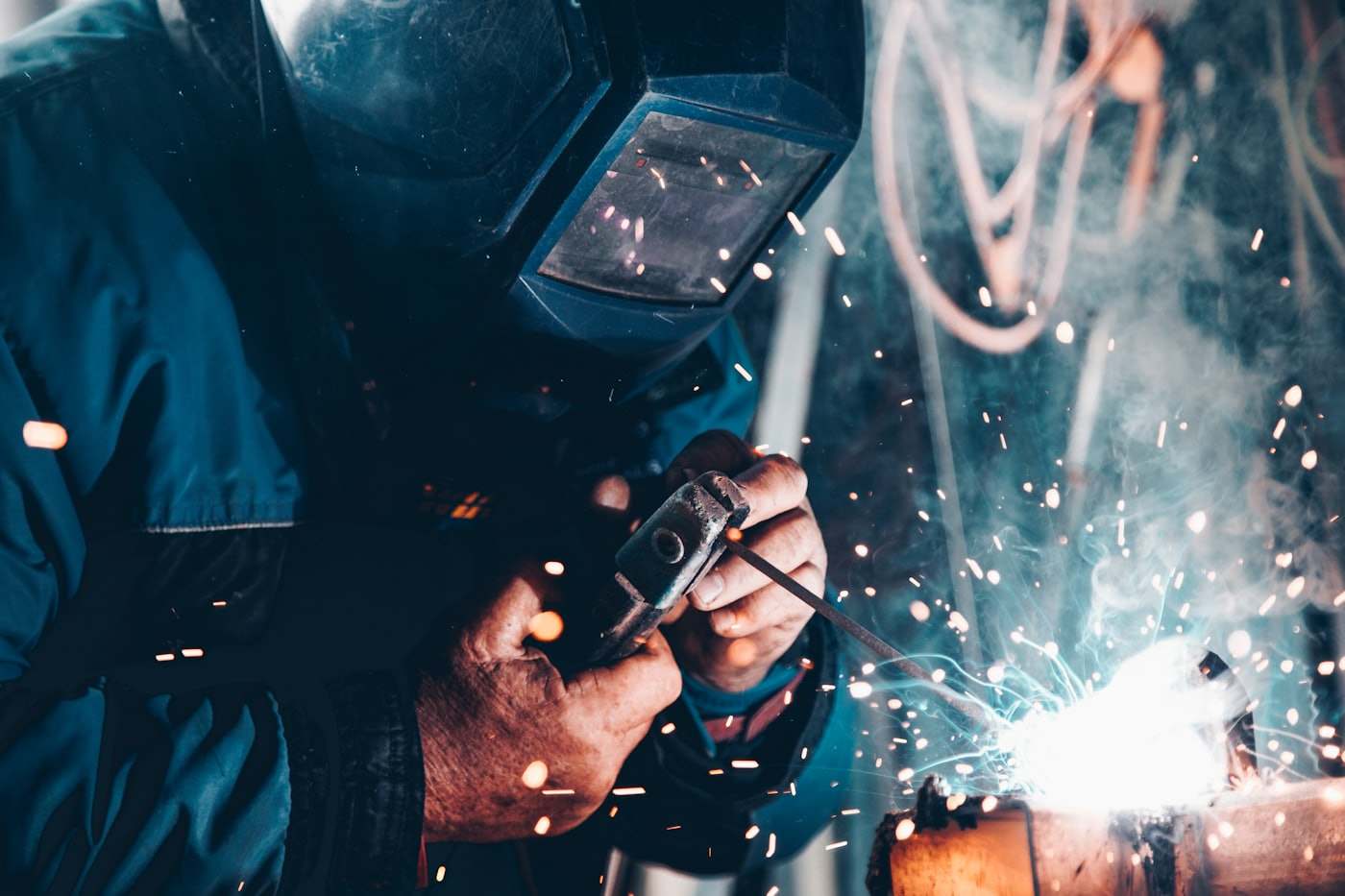
Welding and assembly turns cut and bent parts into finished weldments: frames, brackets, enclosures, tanks and skids. CutLinq sources TIG, MIG/MAG and spot welding from workshops in Egypt, the UAE and Saudi Arabia, together with press-in inserts, rivet nuts, threaded studs and bolted sub-assembly. You upload a STEP file with a weld drawing, and receive a binding quote within 12 hours that covers cutting, forming, welding and finishing as one item.
The page explains which welding process suits which material and thickness, what tolerances a welded assembly can hold, how to specify welds on a drawing, and how heat, dust and coastal humidity in the region influence the finishing you should order after welding.
Which welding process for which job
MIG/MAG (GMAW) is the default for mild steel S235JR and S355J2 from 1.5 mm upward: fast, tolerant of mill scale, suitable for structural frames and brackets. TIG (GTAW, argon welding) is used for stainless 1.4301 (304) and 1.4404 (316L) where the weld must stay clean and for aluminium EN AW-5754 and 6061-T6 with AC current. Spot welding joins overlapping sheets of 0.5 to 3 mm without filler, common in galvanised DX51D+Z enclosures and HVAC plenums.
Fillet welds are standard for T-joints and corners; full-penetration butt welds need a bevel above 6 mm and a root gap of 1 to 2 mm. Stitch welding (for example 30 mm weld, 70 mm gap) cuts heat input and distortion on long seams and is often enough for non-pressure sheet metal work.
| Process | Materials | Thickness range | Typical use |
|---|---|---|---|
| MIG/MAG | S235JR, S355J2, DX51D+Z | 1.5 to 25 mm | Frames, skids, brackets |
| TIG | 1.4301 (304), 1.4404 (316L), EN AW-5754, 6061-T6 | 0.8 to 8 mm | Tanks, food equipment, visible seams |
| Spot welding | Steel, galvanised, stainless sheet | 0.5 to 3 mm (per sheet) | Enclosures, panels, ducts |
| Stud welding | Steel, stainless | M4 to M12 studs | Insulation pins, earth points |
Tolerances of welded assemblies
A welded assembly cannot hold laser-cutting tolerances. Individual parts arrive at ±0.1 mm, but heat shrinkage of 0.5 to 1.5 mm per metre of weld seam and angular distortion of 0.5 to 2° are normal. ISO 13920 class B (for example ±2 mm on lengths of 400 to 1000 mm) is a realistic default; class A (±1 mm on the same range) needs fixtures and adds cost.
Where a machined interface must be precise, design the part so that surfaces are machined after welding, or use slotted holes and shims. Tell us which two or three dimensions really matter and we will fixture for those instead of chasing every dimension.
| Feature | ISO 13920 class A | ISO 13920 class B | Achievable with post-machining |
|---|---|---|---|
| Length 120 to 400 mm | ±1 mm | ±2 mm | ±0.1 mm |
| Length 400 to 1000 mm | ±2 mm | ±3 mm | ±0.1 mm |
| Angle (legs up to 400 mm) | ±20 arcmin | ±45 arcmin | ±5 arcmin |
| Flatness over 1000 mm | ±1.5 mm | ±2.5 mm | ±0.2 mm |
Weld quality and inspection
Suppliers in the CutLinq network work to ISO 5817 quality levels: level C is the general default, level B for load-bearing or pressure parts. Welders for structural steel hold ISO 9606-1 qualifications where the drawing calls for them. Visual inspection is included; dye-penetrant testing on stainless seams, ultrasonic testing on thick butt welds and leak testing on tanks are quoted as separate line items.
State the required quality level, any NDT and whether you need a weld map or an inspection report. For stainless tanks in food or pharmaceutical use, specify inside seams ground flush and passivated.
- Default: ISO 5817 level C, visual inspection, weld spatter removed
- Load-bearing: ISO 5817 level B, qualified welders per ISO 9606-1, weld map on request
- Stainless food contact: TIG, purge gas on the back side, seams ground and pickled or passivated
- Tanks: hydrostatic or air leak test at the pressure you specify
Assembly: inserts, studs and fasteners
Most enclosures and brackets are cheaper to assemble with hardware than with welding. Self-clinching nuts (M3 to M10), standoffs and studs press into sheets from 0.8 mm, rivet nuts suit closed sections and pre-painted parts, and tapped holes make sense from 3 mm thickness (a minimum of two full threads). Blind rivets join dissimilar materials such as aluminium panels to steel frames without galvanic problems when the rivet is insulated.
We also supply bolted sub-assemblies: a frame with its panels, hinges, locks and gaskets fitted, so your team receives one item instead of a kit. List the hardware standard (DIN 933, ISO 4762, A2 or A4 stainless) and torque values if they matter.
Finishing after welding in the MENA climate
Welded steel left bare will rust within weeks in Alexandria, Jeddah or Dubai coastal air. Order hot-dip galvanising (55 to 85 µm) for outdoor structures, or powder coating at 60 to 120 µm after blasting for visible parts; for the two combined, use a duplex system. Vent holes of 10 mm minimum are needed in closed sections for galvanising. Stainless seams should be pickled to remove the heat tint that otherwise corrodes in Gulf humidity. Aluminium weldments can be anodised, but the weld zone and filler 5356 anodise slightly darker than the parent metal.
Design tips
- Keep sheet thickness ratios below 3:1 at a joint; welding 1 mm to 6 mm burns through the thin side.
- Add a bevel of 30 to 45° for butt joints above 6 mm and leave a 1 to 2 mm root gap.
- Use tab-and-slot features on laser-cut parts so the assembly self-locates and needs less fixturing.
- Specify stitch welds (for example 30 mm on, 70 mm off) on seams longer than 300 mm to limit distortion.
- Keep a 10 mm clearance between weld seams and holes that must stay round; weld shrinkage distorts nearby holes.
- Leave 3 mm of machining allowance on faces that must be flat within 0.1 mm after welding.
- Show weld symbols per ISO 2553 on the drawing and state the ISO 5817 quality level once in the title block.
Applications
| Industry | Example parts | Typical material |
|---|---|---|
| HVAC | Plenums, unit frames, filter housings | DX51D+Z 1.0 to 2.0 mm, S235JR angle |
| Solar | Mounting brackets, tracker frames | S355J2 galvanised, EN AW-6063 |
| Food and beverage | Tanks, tables, hoppers | 1.4301 (304), 1.4404 (316L) 1.5 to 3 mm |
| Machinery OEM | Machine bases, guards, cabinets | S235JR 3 to 12 mm |
| Signage | Letter boxes, pylon structures | 1.4301 (304), EN AW-5754 |
| Oil and gas | Skids, pipe supports, walkways | S355J2, 1.4404 (316L) |
| Electrical | Enclosures, cable trays | DX51D+Z, 1.4301 (304) |
Pricing and lead time
Three factors set the price of a weldment: the total seam length and process (TIG on stainless costs roughly two to three times MIG on mild steel per metre), the fixturing and tolerance class demanded, and the post-weld finishing such as grinding, pickling or galvanising. Quantity helps less than in laser cutting, because welding labour is per part, but fixtures made for 50 pieces reduce unit time by 20 to 30%. Typical lead time is 5 to 10 working days for simple brackets and frames, 10 to 15 working days for tanks or assemblies with galvanising or powder coating.
Frequently asked questions
Yes, by TIG or pulsed MIG. Around the seam, 6061-T6 loses 30 to 40% of its strength in the heat-affected zone; 5754 and 5083 lose much less. Design with the annealed strength or place welds away from the highest-stress area.
Upload your STEP file and weld drawing and receive a binding quote for cutting, welding and finishing within 12 hours.