TIG vs MIG Welding: Which to Specify
Speed, appearance, thickness range and material fit compared, with a worked example choosing between the two
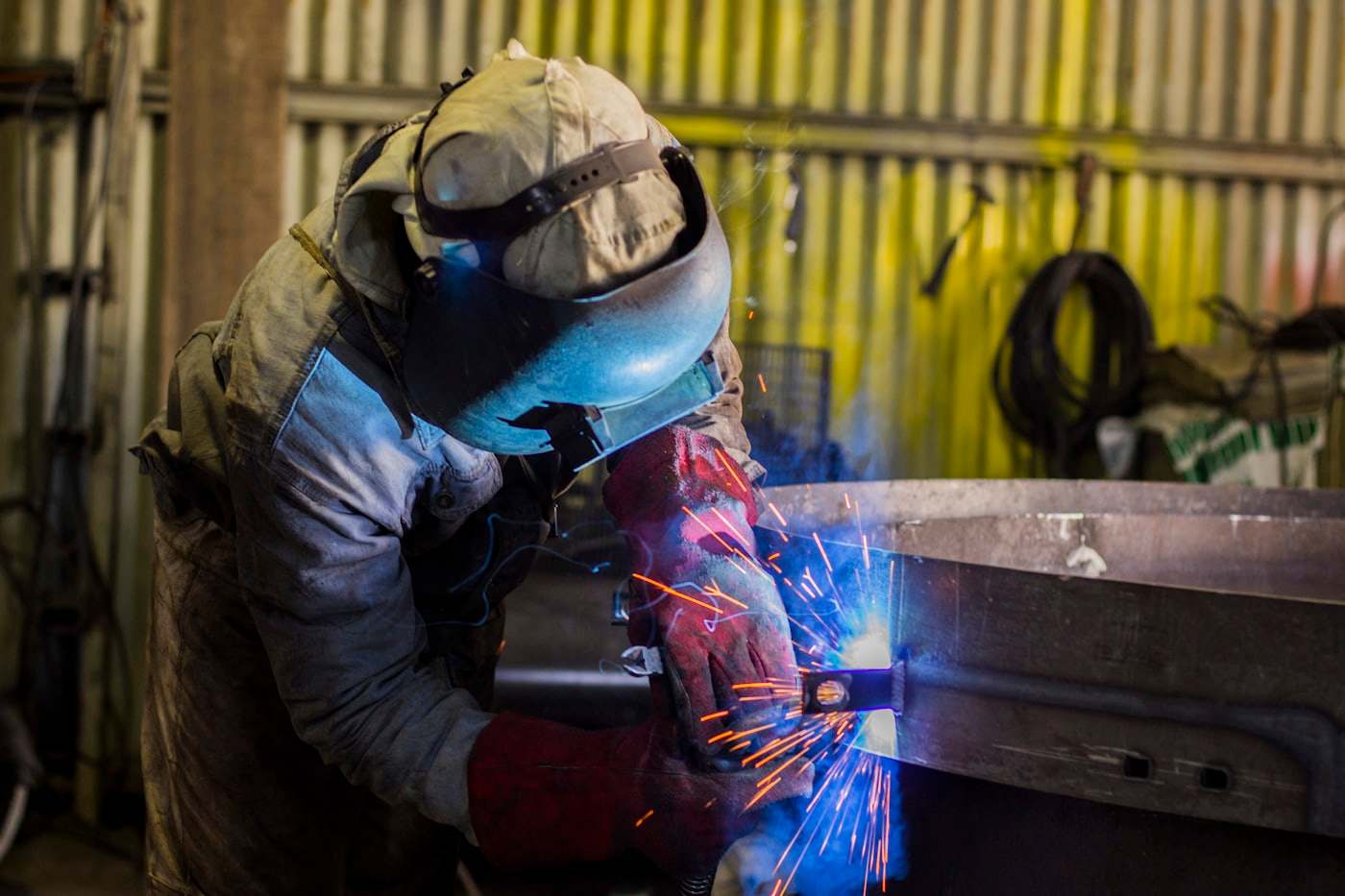
TIG welding (argon-shielded tungsten arc, called lahaam argon in the region) gives a cleaner, more controlled weld but runs 2-4 times slower than MIG; MIG welding is faster and better suited to thicker material and longer production runs but leaves a rougher bead that usually needs grinding for a visible finish. Which to specify depends on material thickness, whether the weld will be visible, and production volume.
This page compares the two directly and works through choosing a process for a stainless food-equipment frame where appearance and hygiene both matter.
Speed and thickness range
MIG welding deposits filler wire continuously and suits material from about 1 mm up to 20+ mm efficiently, making it the default for structural steel fabrication, thicker brackets and any job where welding speed drives cost. TIG welding is manual, feeding filler by hand, and is efficient on thin material (0.5-3 mm) where precision and heat control matter more than speed, but becomes slow and costly on material thicker than about 6-8 mm.
For a typical 3 mm steel bracket, MIG welding takes roughly a third to a quarter of the time TIG would take for the same joint length, which is why production welding of standard brackets and frames is almost always MIG unless a specific reason calls for TIG.
| Factor | TIG (argon, GTAW) | MIG (GMAW) |
|---|---|---|
| Best thickness range | 0.5-6 mm | 1-25 mm |
| Relative speed | 1x (slower) | 2-4x faster |
| Weld appearance as-welded | Clean, minimal spatter | Rougher, some spatter |
| Skill/cost per metre of weld | Higher | Lower |
| Typical use | Thin sheet, visible welds, aluminium, stainless | Structural steel, thicker plate, production runs |
Weld appearance and finishing
TIG produces a smooth, evenly rippled bead with almost no spatter, which is why it is the standard choice for visible stainless equipment, architectural metalwork, and thin sheet where the weld will not be ground flush afterward. MIG welds are functional but rougher, with more spatter around the joint, and are typically ground or dressed if the weld will be visible in the finished product.
For a part that will be powder coated or painted, MIG weld roughness is largely hidden by the coating thickness (60-120 microns) and grinding is often skipped for non-visible structural welds, saving labour cost.
Material fit: steel, stainless, aluminium
Mild and structural steel weld well with either process; MIG is the default for cost and speed on anything over about 3 mm, TIG is chosen for thin sheet or visible joints. Stainless steel is commonly TIG welded for thin sheet (under 3 mm) to control heat input and avoid sensitisation and warping, and MIG welded for thicker stainless plate and structural stainless framing where speed matters more than a pristine bead.
Aluminium is more often TIG welded in the region for both thin and moderate thickness because TIG gives better control over the aluminium oxide layer and heat input, reducing porosity; MIG (using a pulsed process) is used for thicker aluminium structural work and higher-volume production where TIG would be too slow.
| Material | Thin sheet (under 3 mm) | Thick plate (over 6 mm) |
|---|---|---|
| Mild/structural steel | Either; MIG for speed | MIG standard |
| Stainless 1.4301/1.4404 | TIG preferred | MIG for structural, TIG for visible |
| Aluminium 5754/6061 | TIG preferred | Pulsed MIG for volume, TIG for critical joints |
Worked example: a stainless food-equipment frame
A frame for food-processing equipment in 2 mm 1.4301 (304) stainless needs welds that are hygienic (no crevices to trap bacteria), visually acceptable without heavy grinding, and resistant to washdown corrosion. At 2 mm thickness, MIG welding would risk burn-through and leave a rough, spatter-prone bead needing significant grinding to achieve a smooth, cleanable finish -- adding labour cost that offsets MIG's speed advantage.
TIG welding was specified instead: slower per metre of weld, but the resulting bead needed only light polishing to reach a hygienic, smooth finish, and the lower, more controlled heat input reduced the risk of sensitisation at the weld that could otherwise create a corrosion-prone band in this washdown environment.
Design tips
- Specify TIG for stainless or aluminium sheet under 3 mm, or for any weld that will remain visible without heavy grinding.
- Specify MIG as the default for mild and structural steel over 3 mm where the weld will be ground, painted or hidden; it is faster and lower cost per metre of weld.
- For hygienic or food-contact stainless equipment, request TIG welding and specify that welds be ground and polished smooth to avoid bacteria-trapping crevices.
- On thin aluminium (under 2 mm), avoid MIG welding where possible; burn-through risk is high and TIG gives better control.
- For large structural steel fabrications with long weld runs, MIG keeps cost down; reserve TIG for the specific joints that will be visible in the finished assembly.
- If a weld must resist coastal or chloride exposure in stainless, request TIG with controlled heat input and post-weld pickling to reduce sensitisation risk.
- When in doubt, tell us whether the weld will be visible, load-bearing, or exposed to washdown/corrosion, and we will recommend the process rather than defaulting to the faster option.
Applications
| Industry | Example parts | Typical process |
|---|---|---|
| Structural fabrication | Frames, brackets, beams | MIG |
| Food and pharma equipment | Hygienic stainless frames, hoppers | TIG |
| Architectural and signage | Visible stainless or aluminium panels | TIG |
| Automotive and motorsport | Roll cages, exhaust systems | TIG |
| HVAC ducting and brackets | Galvanised and mild steel supports | MIG |
| Aluminium boats and structures | Hull frames, marine brackets | TIG (thin), pulsed MIG (thick) |
Pricing and lead time
Weld process choice affects price mainly through labour time (TIG runs 2-4 times slower per metre of weld than MIG, and skilled TIG welders command a higher rate), by material thickness (thicker material narrows the practical gap since MIG becomes the only efficient option), and by finishing requirements (visible TIG welds need less grinding labour than visible MIG welds). Standard MIG-welded structural assemblies ship in 3-6 working days; TIG-welded stainless or aluminium assemblies with a finished, polished weld in 5-9 working days depending on joint count and polishing requirements.
Frequently asked questions
TIG gives a cleaner, more controlled result, especially on thin material, but a properly executed MIG weld on structural steel is fully sound and appropriate; MIG is not a lower-quality process, just a faster one with a rougher as-welded appearance.
Upload a DXF or STEP file noting which joints must be visible or hygienic, and receive a binding quote with the recommended weld process within 12 hours.