Stainless Steel CNC Machining
CNC milling and turning of 1.4301 (304), 1.4404 (316L), 1.4305 (303) and 1.4057 (431) parts with passivation and inspection reports
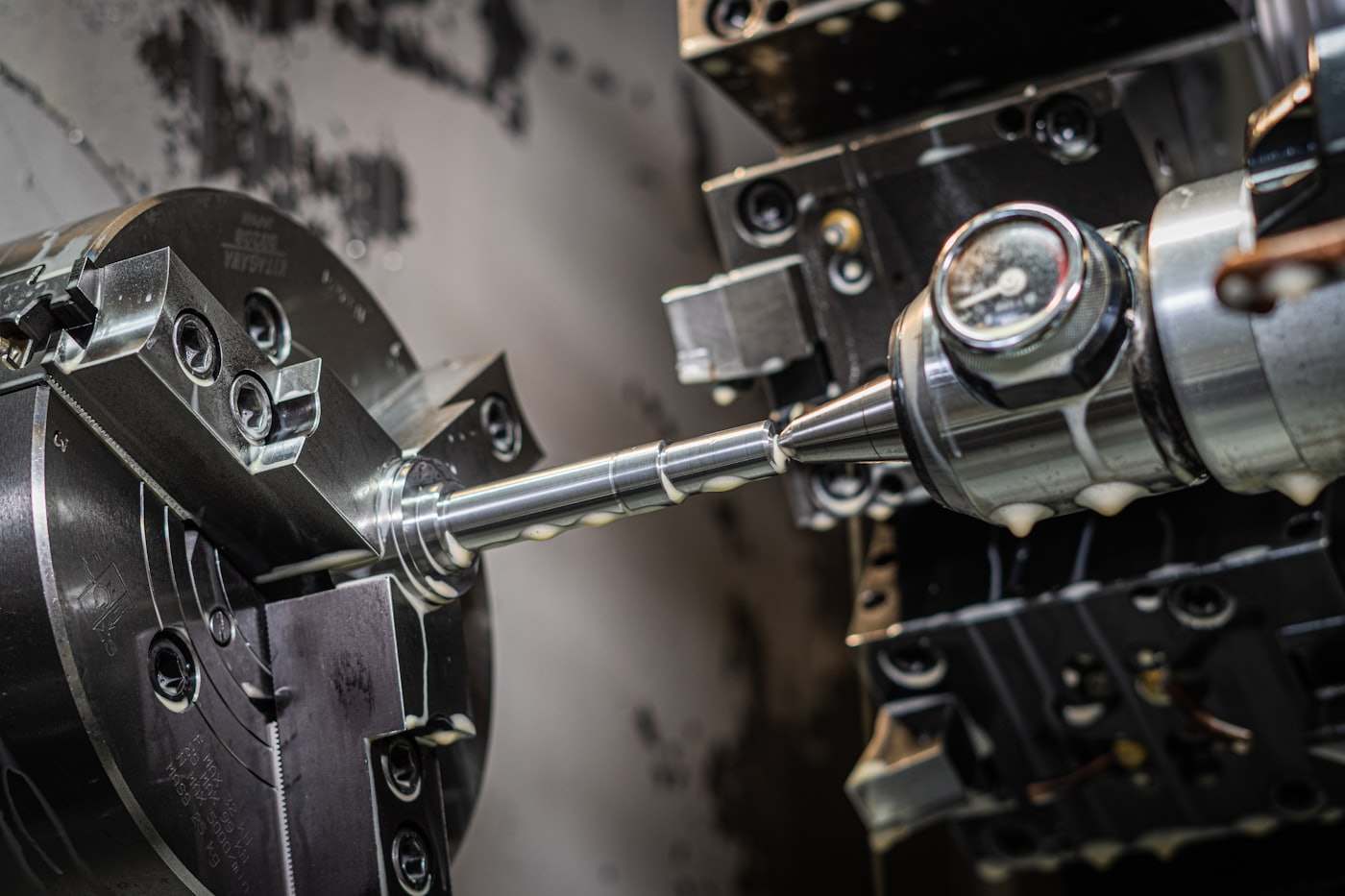
Stainless steel CNC machining covers milling and turning of austenitic, martensitic and precipitation-hardening grades into fittings, shafts, housings, valve bodies and food-contact parts. Standard tolerance is ±0.05 mm, with ±0.01 mm achievable on ground or finish-turned diameters. Machine shops in the CutLinq network run 3, 4 and 5-axis mills and CNC lathes with live tooling, and deliver parts passivated with a dimensional report on request.
Stainless cuts slower than mild steel or aluminium because it work-hardens and conducts heat poorly, so grade choice and design details decide most of the cost. This page explains which grade to pick, what tolerances and surface finishes to expect, and how to design parts that machine efficiently.
Grades and machinability
Machinability is rated against free-cutting steel at 100%. 1.4305 (303) is the free-machining austenitic grade and the right choice for turned fittings that do not need welding or marine exposure; 1.4301 (304) is the general-purpose grade; 1.4404 (316L) resists chlorides and is required for coastal and process-industry parts in Jeddah, Dammam and Dubai; 1.4057 (431) and 1.4542 (17-4PH) are hardenable grades for shafts and pins.
| Grade EN (AISI) | Type | Machinability % | Hardness as supplied HB | Weldable | Typical use |
|---|---|---|---|---|---|
| 1.4305 (303) | Austenitic, free-machining | 70-78 | 160-190 | Poor | Turned fittings, nuts, bushings |
| 1.4301 (304) | Austenitic | 45-50 | 170-200 | Good | General parts, brackets, food contact |
| 1.4404 (316L) | Austenitic, Mo | 35-45 | 170-200 | Good | Marine, chemical, pharma, coastal |
| 1.4057 (431) | Martensitic | 50-55 | 230-280 (hardened 300-340) | Limited | Shafts, pump parts, fasteners |
| 1.4542 (17-4PH) | Precipitation hardening | 40-48 | 280-320 (H900 to 420) | Good | Valve stems, aerospace, high strength |
| 1.4462 (2205 duplex) | Duplex | 25-35 | 230-290 | Good | Oil and gas, seawater, high load |
Milling and turning capabilities
Typical envelopes are 800 x 500 x 500 mm for 3-axis milling, 500 x 400 x 400 mm for 5-axis and diameters to 400 mm by 1000 mm long for turning; larger parts are quoted individually. Cutting speeds are 80-150 m/min with coated carbide for 304 and 316L, about a third of what aluminium allows, which is the main reason a stainless part costs 2-3 times its aluminium equivalent. Rigid fixturing and sharp tools are needed to avoid work-hardened skins that ruin the next pass.
| Feature | Standard | Precision (on request) | Notes |
|---|---|---|---|
| Linear dimensions | ±0.05 mm | ±0.01 mm | ISO 2768-m default if not stated |
| Turned diameter | ±0.03 mm | ±0.008 mm (ground) | Fits h6/g6 possible on ground shafts |
| Hole position | ±0.05 mm | ±0.02 mm | Reamed or bored holes H7 |
| Flatness | 0.05 mm per 100 mm | 0.01 mm per 100 mm | Stress relieve before finish pass |
| Surface roughness, milled | Ra 1.6-3.2 µm | Ra 0.4-0.8 µm | Polished to Ra 0.2 µm for hygienic parts |
| Surface roughness, turned | Ra 1.6 µm | Ra 0.4 µm | Ground Ra 0.2 µm |
| Threads | M2 to M36, 6H/6g | Thread milled | Use roll taps in 304 to avoid breakage |
| Wall thickness, minimum | 1.0 mm | 0.5 mm | Thin walls deflect; add ribs |
Surface finishes and passivation
Machined stainless leaves an as-milled finish of Ra 1.6-3.2 µm with visible tool paths. Options after machining are bead blasting (uniform matt, Ra 1.0-2.5 µm), brushing to 180-240 grit, electropolishing (removes 10-25 µm and brings Ra below 0.4 µm, standard for pharmaceutical and food parts) and mirror polishing. Every stainless part should be passivated in citric or nitric acid after machining to remove embedded tool-steel and iron particles; without it, parts stored in a humid Alexandria or Dammam workshop show rust spots within weeks. Passivation adds no thickness and does not change dimensions.
- Passivation to ASTM A967 or ASTM A380: recommended on all parts
- Electropolish: hygienic, Ra under 0.4 µm, removes 10-25 µm
- Bead blast: hides tool marks, uniform matt, dimensionally neutral
- Laser marking of part numbers: black, no depth, does not affect corrosion
Design for machining stainless
Because material removal is slow, the biggest cost saving is reducing the volume machined away: start from a bar or plate close to the finished size, keep pockets shallow (depth under 4 times cutter diameter) and use standard internal corner radii of 3, 4 or 6 mm. Deep small holes are expensive; a 3 mm hole 40 mm deep in 316L takes several peck cycles and risks a broken drill. Prefer through-holes over blind holes, and specify threads to the depth actually needed, not full depth.
Thin walls under 1.5 mm and large flat faces warp from residual stress; if flatness matters, allow a stress-relief anneal between roughing and finishing and note it on the drawing.
Inspection and documentation
Parts are checked with calipers and micrometers as standard; CMM reports to ±0.005 mm, material certificates EN 10204 3.1 and positive material identification (PMI) by XRF are available on request and are commonly required for oil and gas and pharmaceutical orders in the Gulf. Suppliers in the CutLinq network hold ISO 9001 where the order requires it. Ask for the report at quote stage so the parts are measured before packing, not after.
Design tips
- Use 1.4305 (303) for turned parts that are not welded or exposed to salt; it machines 40-50% faster than 304.
- Keep internal pocket corner radii at 3 mm or larger and pocket depth under 4 times the cutter diameter.
- Limit hole depth to 5 times diameter for holes under 6 mm; deeper holes in 316L cost 2-3 times more.
- Specify thread depth as 1.5 times diameter maximum; longer threads add no strength in stainless.
- Hold ±0.05 mm only where the function needs it and call ISO 2768-m for everything else.
- Keep wall thickness at 1.5 mm minimum on 316L housings to avoid chatter and distortion.
- State the surface finish (as milled, bead blast, Ra 0.8, electropolish) and passivation on the drawing.
Applications
| Industry | Example parts | Typical material |
|---|---|---|
| Food and beverage | Filler nozzles, conveyor shafts, hygienic fittings | 1.4404 (316L) electropolished |
| Oil and gas | Valve stems, instrument manifolds, seal housings | 1.4404 (316L), 1.4462 duplex |
| Water and desalination | Pump sleeves, flanges, nozzles | 1.4404 (316L), 1.4462 |
| Medical and laboratory | Instrument bodies, fixtures, trays | 1.4301 (304), 1.4404 (316L) |
| Machinery OEM | Guide bushings, spindle parts, couplings | 1.4305 (303), 1.4057 (431) |
| Architecture | Glass spider fittings, bolts, standoffs | 1.4301 (304), 1.4404 (316L) polished |
| Electrical | Enclosure fittings, sensor housings | 1.4301 (304) |
Pricing and lead time
Three factors set the price: machining time, which depends on the volume removed and the grade (316L costs roughly 20-30% more to machine than 304, and duplex roughly 60-80% more); tolerance and finish, where ±0.01 mm features or electropolishing add 20-50% to a part; and quantity, since programming and set-up of 1-3 hours are spread over the batch, so 50 parts typically cost 40-60% less each than 5. Lead time is 5-8 working days for milled or turned parts in stock grades, 8-12 working days with passivation and CMM report, and 12-15 working days for 17-4PH or duplex that must be sourced.
Frequently asked questions
304 is fine indoors and for fresh water. Choose 316L for anything within 5 km of the Gulf or Red Sea coast, in contact with chlorinated water, chemicals or food acids; it costs roughly 30-40% more in material and slightly more to machine.
Upload your STEP file with the drawing and receive a binding quote for stainless steel CNC machining within 12 hours.