Stainless Steel Bending
Press brake bending of 304 and 316L sheet from 0.5 to 12 mm with scratch-free faces and ±0.5° angles
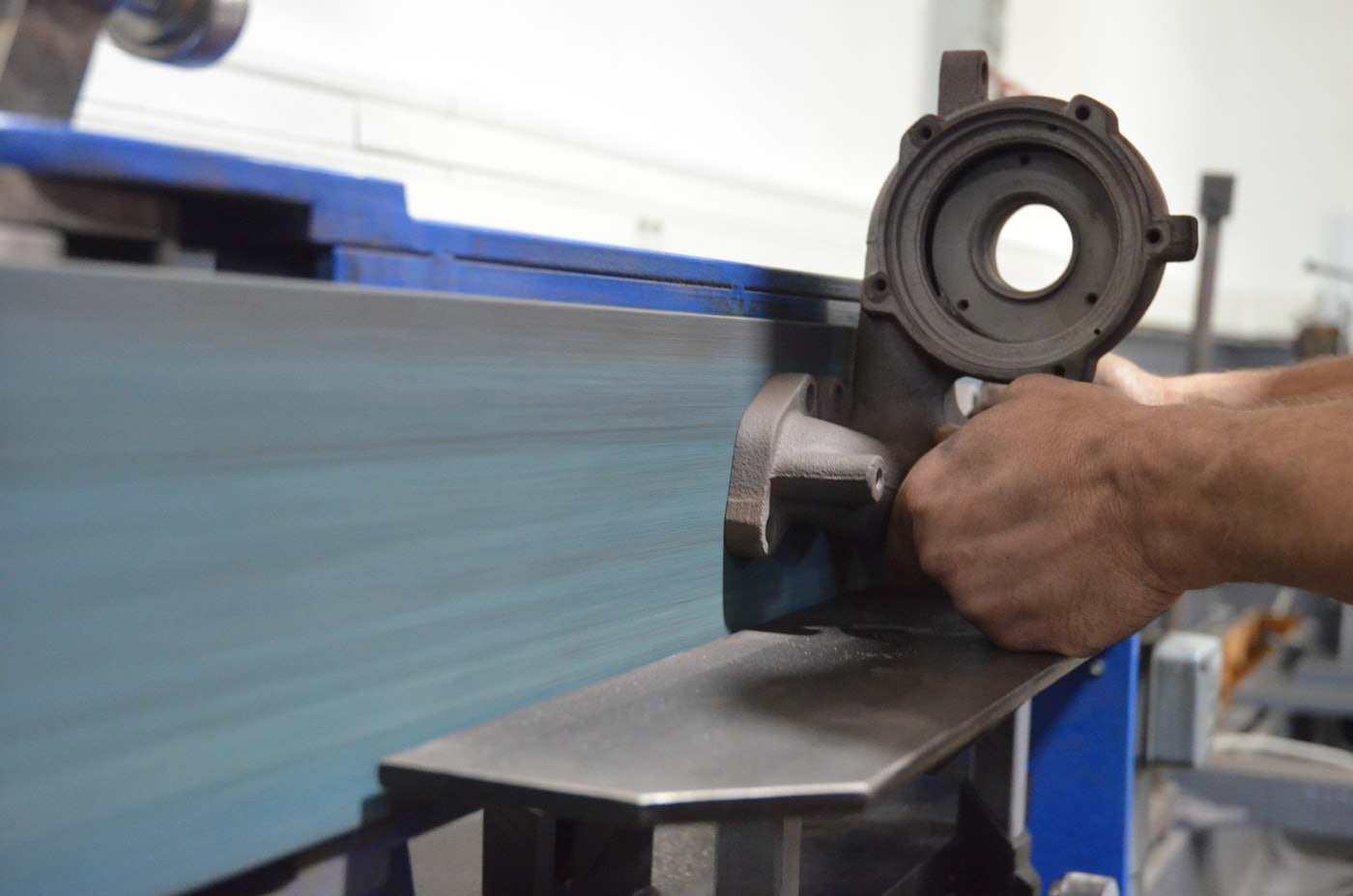
Stainless steel bending forms laser-cut 1.4301 (304) and 1.4404 (316L) blanks into enclosures, kitchen equipment, cladding and brackets on CNC press brakes. Stainless needs about 50-60% more tonnage than mild steel of the same thickness, springs back 2-4° more, and shows every tool mark on a brushed or mirror face. Suppliers in the CutLinq network bend stainless from 0.5 to 12 mm, up to 4000 mm long, with ±0.5° angle tolerance and film-protected faces on request.
This page covers the differences from bending mild steel, the radius and flange rules that apply to austenitic grades, and how to specify a visible-face part so the quote already includes protection and finishing.
Why stainless bends differently from mild steel
Austenitic stainless has a yield strength of 210-250 MPa but work hardens fast, reaching 600 MPa or more in the bend zone. Three effects follow. First, tonnage per metre is roughly 1.5 times that of S235JR, so a 6 mm stainless bend needs the same machine as 9 mm mild steel. Second, springback is larger and less predictable: 304 springs back 3-5° in air bending compared with 1-2° for mild steel, so the press brake over-bends and corrects with a test piece. Third, the minimum inside radius rises to 1-1.5 times thickness; tighter radii crack on the outer surface, especially in 316L with its slightly lower ductility across the rolling direction.
| Property | S235JR mild steel | 1.4301 (304) | 1.4404 (316L) |
|---|---|---|---|
| Yield strength | 235 MPa | 210-250 MPa | 220-260 MPa |
| Tonnage factor (vs S235) | 1.0 | 1.5 | 1.6 |
| Typical springback, air bend | 1-2° | 3-5° | 3-5° |
| Min inside radius | 1 × t | 1-1.5 × t | 1.5 × t |
| Elongation A50 | 24-26% | 45%+ | 40%+ |
Capacity, thickness and tolerances
Sheet from 0.5 to 3 mm is bent on 60-100 tonne machines with polished tooling; 4 to 8 mm on 100-200 tonne machines; 10 to 12 mm needs 300 tonnes and above, and bend length falls to 3000 mm at that thickness. Below 1 mm, stainless tends to deflect between the die shoulders and the angle tolerance widens to ±1°. Measured across a single bend, flange tolerance of ±0.3 mm applies up to 3 mm; for two-bend channels the width tolerance is ±0.5 mm.
| Thickness | Machine | Max bend length | Angle tolerance | Flange tolerance |
|---|---|---|---|---|
| 0.5 - 1.0 mm | 60 - 100 t | 3000 mm | ±1° | ±0.3 mm |
| 1.0 - 3.0 mm | 60 - 100 t | 4000 mm | ±0.5° | ±0.3 mm |
| 3.0 - 6.0 mm | 100 - 200 t | 4000 mm | ±0.5° | ±0.5 mm |
| 6.0 - 10 mm | 200 - 300 t | 4000 mm | ±1° | ±0.8 mm |
| 10 - 12 mm | 300 t and above | 3000 mm | ±1° | ±1.0 mm |
Protecting the visible face
Most stainless parts are visible: kitchen hoods, lift cladding, counters, signage. The die shoulders leave two parallel witness lines on the outside of every bend unless the sheet is protected. Suppliers use one of three methods, in increasing cost: a laser-cutting-grade protective PE film left on through bending; urethane die pads or roller dies that spread the contact; or polishing the bend lines afterwards. Film is standard for 2B and brushed (grit 180-240) finishes; mirror (No. 8) finishes need film plus polished radius tooling.
Grain direction matters on brushed sheet. Bending parallel to the grain has a higher risk of cracking at tight radii, and a bend across the grain on a brushed panel makes the grain visibly change direction at the corner. State the required grain direction on the DXF so the nest is arranged accordingly, even if that costs 10-15% more sheet.
- 2B mill finish: film optional, standard tooling
- Brushed grit 180-240: film required, note grain direction
- Mirror No. 8: film plus polished tools, expect 20-30% surcharge
- Painted or coated stainless: bend before coating, radius 2 × t minimum
Design rules for stainless bends
Minimum flange length for stainless is 4 × thickness plus the inside radius for sheet up to 3 mm and 6 × thickness above that; a 3 mm 304 bracket with 3 mm radius therefore needs 15 mm flanges. Holes must sit 2.5 × thickness plus the radius from the bend line or they distort. Bend reliefs of 1 × thickness prevent tearing at intersecting bends. Where hygienic design applies, for example in food and pharmaceutical equipment sold in Saudi Arabia and the UAE, specify an inside radius of at least 3 mm so the corner can be cleaned and does not trap product.
Corrosion after bending in Gulf and coastal conditions
Bending itself does not reduce corrosion resistance, but tool contamination does. If a press brake tool last bent mild steel, iron particles embed in the stainless surface and show as rust spots within weeks in the salt air of Jeddah, Dammam or Alexandria. Suppliers who bend stainless regularly keep separate tooling or clean tools before a stainless run; ask for this on parts that are not passivated afterwards. For coastal and marine parts specify 1.4404 (316L), which costs roughly 30-40% more than 304, and request pickling and passivation after any welding of the bent parts.
Design tips
- Use an inside radius of 1.5 × thickness for 304 and 316L; do not model sharp bends
- Minimum flange: 4 × t + R up to 3 mm, 6 × t + R above; a 2 mm sheet with 2 mm radius needs 10 mm flanges
- Note the grain direction on brushed panels and accept 10-15% more material for correct nesting
- Keep holes and slots 2.5 × t + R from bend lines, or specify post-bend drilling
- Write 'visible face, no tool marks, film on' on drawings for decorative parts so protection is quoted
- Choose 316L over 304 for parts within 5 km of the coast in the UAE, Saudi Arabia and Alexandria
- For hygienic equipment use inside radii of 3 mm or more and avoid closed hems that trap liquid
Applications
| Industry | Example parts | Typical material |
|---|---|---|
| Commercial kitchens | Hoods, sinks, work tables | 1.4301 (304) 1.0-1.5 mm brushed |
| Food processing | Conveyor guards, hoppers, chutes | 1.4404 (316L) 2-3 mm |
| Architecture | Lift cladding, column covers, handrail brackets | 1.4301 (304) 1.5 mm mirror or brushed |
| Pharmaceutical and labs | Clean room panels, fume hood liners | 1.4404 (316L) 1.5 mm |
| Electrical | Outdoor enclosures, junction boxes | 1.4404 (316L) 2 mm |
| Water and desalination | Tank stiffeners, pipe brackets | 1.4404 (316L) 4-8 mm |
| Signage | Letter returns, plinths | 1.4301 (304) 1.0-1.5 mm |
Pricing and lead time
Stainless bending price is set by the number and length of bends (each is a machine cycle at higher tonnage than steel), the surface requirement (film protection, tool cleaning and post-polishing add 15-30%), and the batch size, since the test-piece correction for springback is repeated per setup. Material grade is the fourth lever: 316L adds 30-40% to the blank cost. Laser-cut and bent 304 parts ship in 4 to 7 working days; mirror-finish or 316L multi-bend enclosures take 7 to 12 working days, with same-day or next-day courier delivery within Cairo, Dubai, Riyadh and Jeddah.
Frequently asked questions
Yes. Film-protected sheet and polished tooling keep the brushed face clean; state 'visible face' on the drawing and which side faces out. Grain direction should be given if the part is seen next to other panels.
Upload your DXF or STEP file and receive a binding quote for stainless cutting and bending within 12 hours.