CNC Plasma Cutting
Fast, economical cutting of mild steel and stainless plate from 3 mm to 50 mm across Egypt, the UAE and Saudi Arabia
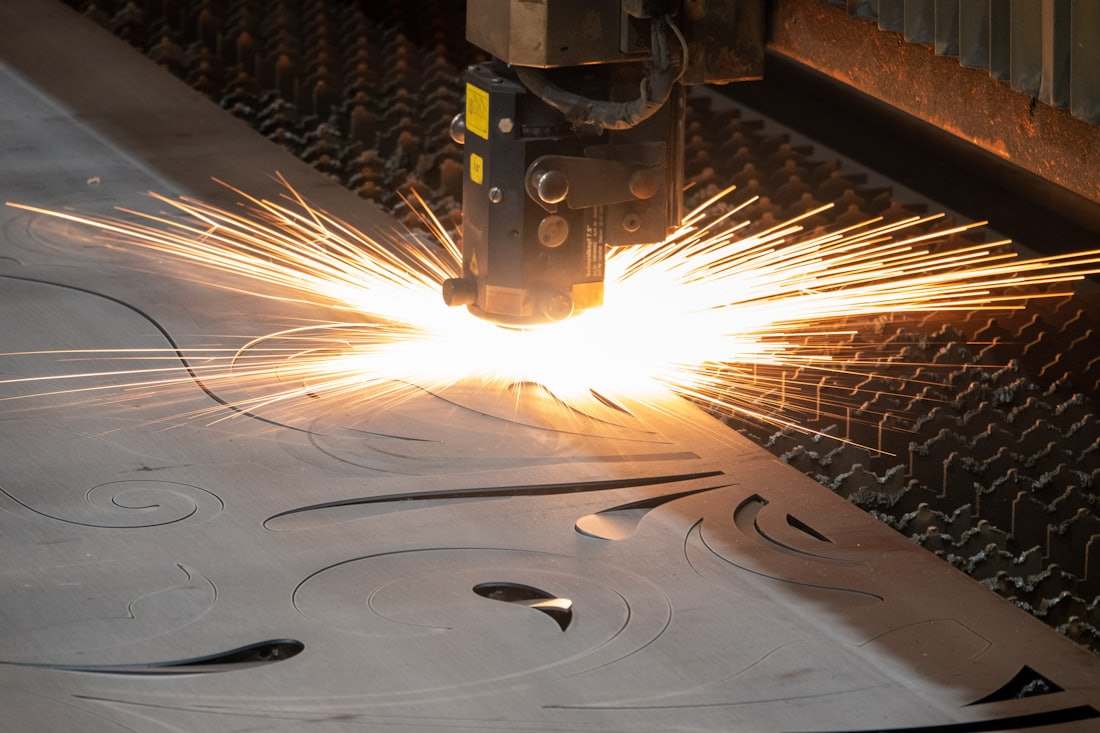
CNC plasma cutting uses an electrically ionised gas jet at around 20,000 °C to melt and blow through conductive metal. It is the most economical way to cut mild steel plate above 10 mm, handles stainless and aluminium up to 40-50 mm, and is standard for structural, agricultural and oil-and-gas fabrication in Egypt, the UAE and Saudi Arabia. Expect ±0.5 to ±1.0 mm accuracy, a 1.5-4 mm kerf and a slight bevel on the cut edge.
This page covers plate thickness ranges, tolerances, edge quality, the difference between conventional and high-definition plasma, and when a fiber laser or waterjet is the better choice. It ends with what to include in your DXF so the quote is binding.
How CNC plasma cutting works
A plasma torch forces compressed air, oxygen or nitrogen through a narrow copper nozzle while an electric arc passes through the gas. The gas ionises into plasma, melts the metal, and the gas flow ejects the molten material from the kerf. A CNC gantry moves the torch along the DXF contour at 0.5 to 6 m/min depending on thickness.
High-definition (HD) plasma systems constrict the arc further with a secondary shield gas, giving narrower kerf, less bevel and better hole quality than conventional air plasma. Most suppliers in the CutLinq network run HD plasma tables of 1500 x 3000 mm to 2500 x 6000 mm, often with a bevel head for weld preparation.
Thickness range by material
Plasma cuts any electrically conductive metal. Mild steel gives the cleanest result because oxygen plasma adds exothermic energy. Aluminium and stainless need nitrogen or air-nitrogen mixes and produce a rougher, darker edge. The figures below are production-quality cuts; severance cuts (rough, for scrap or later machining) are possible 20-30% thicker.
| Material | Production cut | Pierce limit | Typical kerf | Notes |
|---|---|---|---|---|
| Mild steel S235JR / S355JR | 3-40 mm | 50 mm | 1.5-3.5 mm | Best edge quality, oxygen plasma |
| Stainless 1.4301 (304) / 1.4404 (316L) | 3-30 mm | 40 mm | 2.0-4.0 mm | Nitrogen gas, dark oxide edge |
| Aluminium EN AW-5754 / 6061 | 3-25 mm | 40 mm | 2.0-4.0 mm | Dross-prone below 6 mm |
| Galvanised DX51D+Z | 3-12 mm | 12 mm | 1.5-3.0 mm | Zinc burn-off 5-10 mm from edge |
| Copper Cu-ETP / brass CuZn37 | 3-20 mm | 25 mm | 2.5-4.0 mm | High conductivity, slower speeds |
Tolerances and edge quality
Plasma is a thermal process with a wider kerf than laser, so accuracy and edge angle depend strongly on thickness and torch condition. ISO 9013 classifies thermal cut edges by perpendicularity (u) and roughness (Rz5). HD plasma reaches ISO 9013 range 2-3 on mild steel 6-25 mm; conventional plasma sits at range 4-5.
Holes are the weak point. A hole smaller than 1.5 times plate thickness will taper and show an entry notch where the arc started. For bolt holes in 12 mm plate specify 20 mm minimum or ask for drilling after cutting.
| Feature | HD plasma | Conventional plasma | Fiber laser (for comparison) |
|---|---|---|---|
| Dimensional tolerance | ±0.5 mm | ±1.0 mm | ±0.1 to ±0.2 mm |
| Edge bevel angle | 1-3° | 3-6° | 0-1° |
| Minimum hole diameter | 1.5 x thickness | 2 x thickness | 0.7-1 x thickness |
| Heat-affected zone | 0.5-1.5 mm | 1-3 mm | 0.1-0.5 mm |
| Surface roughness Rz | 40-80 µm | 80-160 µm | 10-40 µm |
Plasma versus laser versus waterjet
Below 10 mm a fiber laser is faster, more accurate and usually cheaper per metre because it needs no secondary deburring. Between 10 and 25 mm the two processes overlap: laser gives a square, clean edge; plasma gives a lower price on simple shapes. Above 25 mm plasma is the only economical thermal option, and above 40 mm plasma competes with oxy-fuel or waterjet.
Waterjet has no heat-affected zone and cuts any thickness, but runs 5-10 times slower than plasma. Choose it only when hardened steel, heat-sensitive alloys or a machined-quality edge are required.
- Choose plasma for mild steel 10-40 mm brackets, base plates, gussets, flanges and structural fittings.
- Choose laser for sheet under 10 mm, tight tolerances, small holes and parts that go straight to bending.
- Choose waterjet for hardened or heat-treated plate, thick aluminium and stone or composite inlays.
- Plasma bevel heads cut 30-45° weld preparations in one pass, saving a grinding operation before welding.
Regional considerations
Dust and sand in Gulf and Egyptian workshops shorten consumable life, so reputable suppliers change nozzles and electrodes on a piece-count schedule; ask for a fresh consumable set on precision batches. Plate stock in the region is mostly S235JR and S355JR to EN 10025 and ASTM A36 for oil-and-gas work, in 6, 8, 10, 12, 16, 20 and 25 mm. Thicknesses outside this list add 2-5 working days for material sourcing.
For coastal sites in Alexandria, Jeddah, Dubai or Dammam, plasma-cut mild steel should be blasted and primed or hot-dip galvanised within days, because the oxide edge attracts humidity and starts rusting fast.
Design tips
- Keep hole diameters at or above 1.5 x plate thickness; below that, request drilling or reaming after cutting.
- Allow 1.5-4 mm kerf: draw the finished contour and let the supplier apply kerf compensation, do not offset it yourself.
- Add 2-3 mm machining allowance on any edge that will be milled or turned afterwards to remove the heat-affected zone.
- Keep slot widths at 4 mm minimum on 10 mm plate and 6 mm on 20 mm plate.
- Leave 1 x thickness between adjacent cut lines; thinner webs warp and can be burnt through.
- Mark bevel edges in the DXF with a separate layer and note the angle (30°, 37.5° or 45°) and land.
- Nest parts on standard 1500 x 3000 or 2000 x 6000 mm plate sizes to avoid paying for offcuts.
Applications
| Industry | Example parts | Typical material |
|---|---|---|
| Construction and steelwork | Base plates, gussets, stiffeners, splice plates | S235JR / S355JR 8-30 mm |
| Oil, gas and energy | Flange blanks, pipe supports, skid frames | S355JR, ASTM A36, 1.4404 (316L) |
| Agriculture | Plough shares, disc blades, trailer chassis parts | S355JR, Hardox 400 10-16 mm |
| Heavy machinery | Counterweights, bucket lips, wear plates | S355JR, wear steel 12-40 mm |
| Solar and utilities | Pile caps, mounting brackets, earthing plates | S235JR 6-12 mm, hot-dip galvanised |
| Marine and ports | Bollards, deck fittings, hull brackets | S355JR, 1.4404 (316L) 10-25 mm |
Pricing and lead time
Plasma price is driven by three factors: plate thickness (cutting time rises steeply above 20 mm), total cut length including pierces (each pierce on 25 mm plate costs as much as roughly 100 mm of cut), and material grade (316L costs roughly 4-5 times S235JR per kilogram). Secondary operations such as drilling, bevelling and blasting add on top. Realistic lead times are 2-4 working days for standard mild steel plate in stock sizes, 4-7 working days for stainless, aluminium or non-standard thicknesses, and 7-10 working days when galvanising or painting follows.
Frequently asked questions
Production-quality cuts up to 40 mm on HD plasma; severance cuts to 50 mm. Above that we route the job to oxy-fuel or waterjet.
Upload your DXF or STEP file and receive a binding plasma cutting quote within 12 hours.