Titanium CNC Machining
CNC milling and turning of Ti Grade 2 and Ti Grade 5 (Ti-6Al-4V) for medical, aerospace, marine and chemical parts
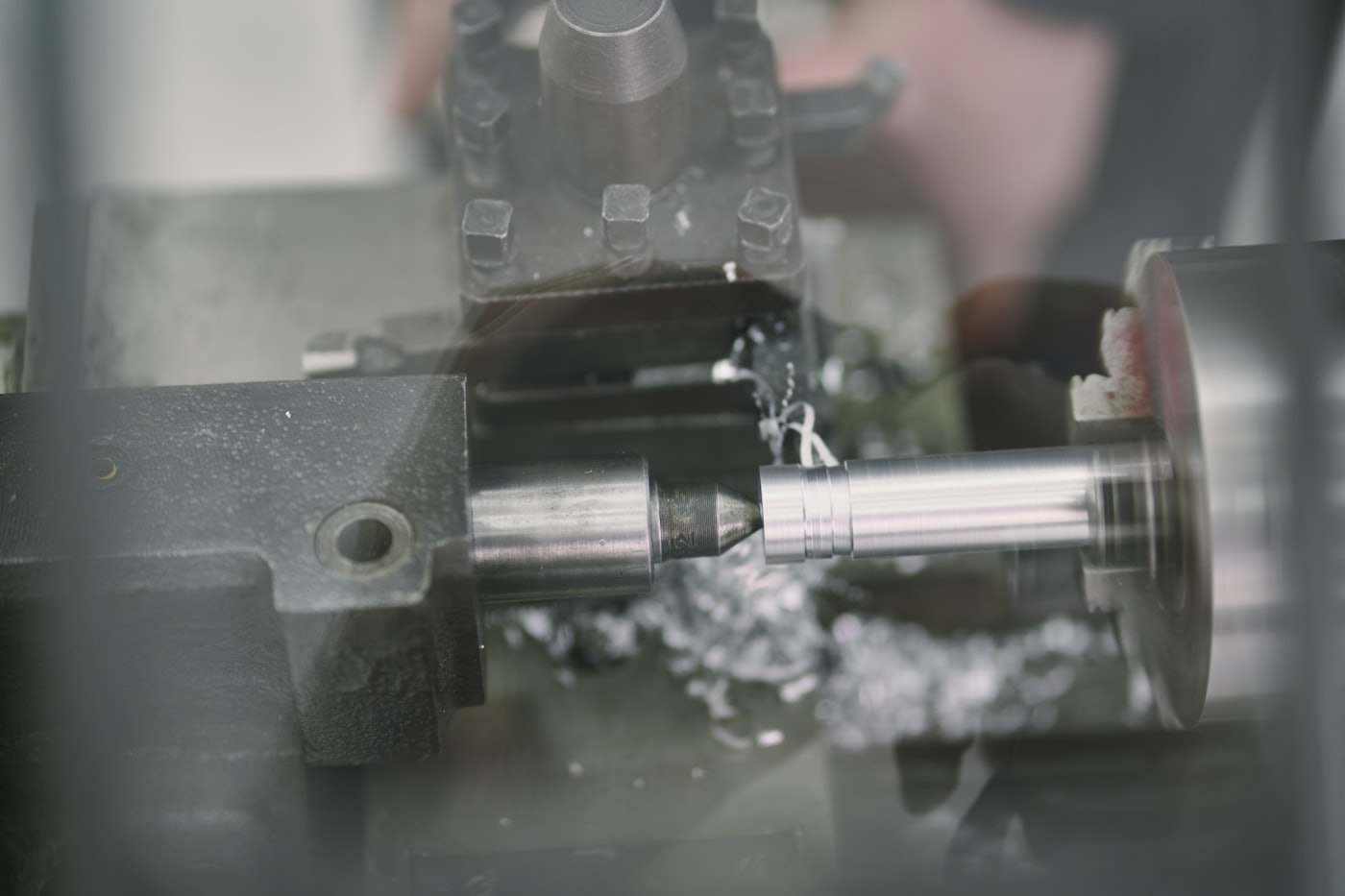
Titanium CNC machining produces parts from commercially pure Ti Grade 2 and the alpha-beta alloy Ti Grade 5 (Ti-6Al-4V, 3.7165) for implants, aerospace fittings, seawater pump components and chemical process parts. Titanium has the strength of alloy steel at 57% of its density, is immune to chloride corrosion and is biocompatible, but it machines at one fifth to one tenth the speed of steel. Machine shops in the CutLinq network mill and turn titanium to ±0.05 mm standard, ±0.01 mm on request, using low-speed high-feed strategies, flood coolant and rigid fixturing.
This page gives the grades, realistic tolerances, the design rules that keep cutting time and tool wear under control, and what to expect in price and lead time compared with stainless steel.
Titanium grades for machining
Grade 2 is the workhorse commercially pure grade: excellent corrosion resistance, moderate strength, easier to machine and to form. Grade 5 is the alloy used for 80% of titanium parts worldwide: twice the strength of Grade 2, heat-treatable, harder to machine. Grade 23 (Ti-6Al-4V ELI) is the low-interstitial version required for implants. Bar stock in 10-150 mm diameters and plate in 5-50 mm are available through importers in Dubai and Cairo; expect 2-6 weeks for unusual sizes.
| Grade (EN) | Composition | Yield MPa | Tensile MPa | Density g/cm3 | Machinability vs 304 | Typical use |
|---|---|---|---|---|---|---|
| Ti Grade 1 (3.7025) | CP, lowest O2 | 170 | 240 | 4.51 | 1.0 x | Deep-drawn, chemical liners |
| Ti Grade 2 (3.7035) | CP | 275 | 345 | 4.51 | 0.8 x | Heat exchangers, pumps, marine fittings |
| Ti Grade 5 (3.7165) | Ti-6Al-4V | 880 | 950 | 4.43 | 0.4 x | Aerospace, racing, general structural |
| Ti Grade 23 (3.7165 ELI) | Ti-6Al-4V ELI | 795 | 860 | 4.43 | 0.4 x | Implants, surgical instruments |
| Ti Grade 7 (3.7235) | CP + 0.15% Pd | 275 | 345 | 4.51 | 0.8 x | Acid service, chemical plants |
| Ti Grade 9 (3.7195) | Ti-3Al-2.5V | 485 | 620 | 4.48 | 0.6 x | Tubing, bicycle frames, hydraulics |
How titanium is machined
Titanium's low thermal conductivity (7 W/mK, against 16 for stainless and 170 for aluminium) sends 80% of cutting heat into the tool edge, and its low modulus lets thin sections spring away from the cutter. Shops therefore run 40-80 m/min surface speed with sharp uncoated or AlTiN-coated carbide, high feed per tooth, constant chip load and high-pressure coolant. Climb milling is mandatory; interrupted cuts and dwell are avoided. Titanium chips are flammable, so swarf is kept dry and separate.
Turning bar to Grade 5 fittings is straightforward at 50-70 m/min; deep pockets and thin walls are where cost climbs. Threads are thread-milled rather than tapped above M8 to avoid seizure, and holes are drilled with through-coolant carbide.
| Feature | Standard | Precision | Notes |
|---|---|---|---|
| Linear dimensions | ±0.05 mm | ±0.01 mm | ISO 2768-m unless stated |
| Turned diameter | ±0.03 mm | ±0.008 mm ground | Grade 5 grinds well with SiC wheels |
| Hole position | ±0.05 mm | ±0.02 mm | Reamed H7 with titanium-specific reamers |
| Surface roughness, milled | Ra 1.6-3.2 µm | Ra 0.4-0.8 µm | Polish to Ra 0.1 µm for implants |
| Minimum wall | 1.5 mm | 0.8 mm | Low modulus, deflection risk |
| Pocket depth | 3 x cutter diameter | 5 x with reduced step-over | Deeper costs 2-3 x |
| Threads | M3 to M24 | Thread milled | Use 6H, avoid fine pitch under M6 |
| Part envelope, milling | 600 x 400 x 300 mm | Larger on request | Bar to 150 mm diameter for turning |
Surface treatments for titanium
Titanium forms its own oxide and rarely needs protection, but three treatments are common. Colour anodising (type III, 0.05-0.2 µm interference oxide) gives gold, blue, purple and bronze for identification of surgical instruments and consumer parts without dyes. Type II anodising builds 2-3 µm for anti-galling on threaded parts. Bead blasting gives a uniform matt that hides tool marks; electropolishing and passivation in nitric acid follow for implant-grade parts. Machined titanium should not be left in contact with steel fixtures before cleaning to avoid iron contamination.
- Colour anodising: 0.05-0.2 µm, no dimensional change, gold, blue, purple, bronze
- Type II anodising: 2-3 µm, anti-galling for threads and sliding parts
- Bead blast: Ra 1.0-2.0 µm uniform matt
- Electropolish and passivate: implant and pharma parts
Design rules that control titanium cost
Because every cubic centimetre removed costs several times what it costs in aluminium, design from a stock size that leaves 2-3 mm on each face at most. Keep pockets under 3 times the cutter diameter in depth, corner radii at 4 mm or more, and walls at 1.5 mm or more. Avoid blind holes with flat bottoms and deep small tapped holes; a 20 mm deep M4 in Grade 5 is a broken-tap risk and is better as a helicoil or a thread-milled M5. Where titanium contacts stainless or aluminium in service, add isolation; titanium is noble and will corrode the other metal in Gulf sea water.
Titanium versus stainless steel and aluminium
Grade 5 offers a strength-to-weight ratio about 1.8 times that of 1.4404 (316L) and matches 316L in seawater; it is the right choice where mass matters or where 316L would pit, for example in desalination brine, offshore fittings and racing components. Where neither weight nor chlorides matter, 316L costs roughly one fifth as much finished and 7075-T6 aluminium about one tenth. Titanium is not a general substitute; it is chosen for a specific reason.
Design tips
- Start from a stock bar or plate within 2-3 mm of the finished envelope; removing 50% of the blank doubles the price.
- Keep pocket depth under 3 times cutter diameter and use corner radii of 4 mm or larger.
- Minimum wall 1.5 mm; add temporary ribs if the design needs thinner and remove them in a final pass.
- Thread depth 1.5 x diameter maximum; specify thread milling or helicoil above M8 and below M4.
- Use ISO 2768-m as the general tolerance and reserve ±0.01 mm for bearing seats and sealing faces.
- Call out Grade 2 rather than Grade 5 if strength above 275 MPa yield is not required; it machines 2 times faster.
- Specify the surface treatment (as machined, bead blast, colour anodised, electropolished) and the Ra on the drawing.
Applications
| Industry | Example parts | Typical material |
|---|---|---|
| Medical | Implant screws, bone plates, surgical instrument handles | Ti Grade 23 (ELI), Grade 5 |
| Desalination and marine | Pump impellers, valve trim, heat exchanger tube sheets | Ti Grade 2 |
| Oil and gas | Subsea fittings, riser components, instrument bodies | Ti Grade 5, Grade 2 |
| Aerospace and defence | Brackets, fittings, fasteners | Ti Grade 5 |
| Chemical process | Agitator shafts, nozzles, flanges | Ti Grade 2, Grade 7 |
| Motorsport and cycling | Axles, linkages, custom fasteners | Ti Grade 5, Grade 9 |
| Consumer and jewellery | Watch cases, pens, rings | Ti Grade 2, Grade 5 colour anodised |
Pricing and lead time
Price is set by material (Grade 5 bar costs roughly 8-12 times 1.4301 (304) per kilogram and Grade 2 roughly 6-8 times), machining time (a Grade 5 part typically takes 2.5-4 times the spindle hours of the same part in 316L and 8-10 times the hours of 6061-T6, with tool cost added on top) and quantity, where programming and first-part proving are fixed costs, so 20 parts cost roughly half per part of 3 parts. Realistic lead time is 7-10 working days when bar is in stock, 10-15 working days with anodising or polishing and inspection reports, and 3-6 weeks in total when the size must be imported.
Frequently asked questions
Machine shops in the CutLinq network in Egypt and the UAE machine titanium in-house; Grade 5 bar in common diameters is stocked by importers in Dubai and Cairo. Unusual plate sizes and Grade 23 are ordered to project.
Upload your STEP file and drawing for titanium CNC machining and receive a binding quote within 12 hours.