Aluminium Welding
AC TIG and pulsed MIG welding of 5754, 5083, 6061 and 6082 sheet, plate, tube and extrusions
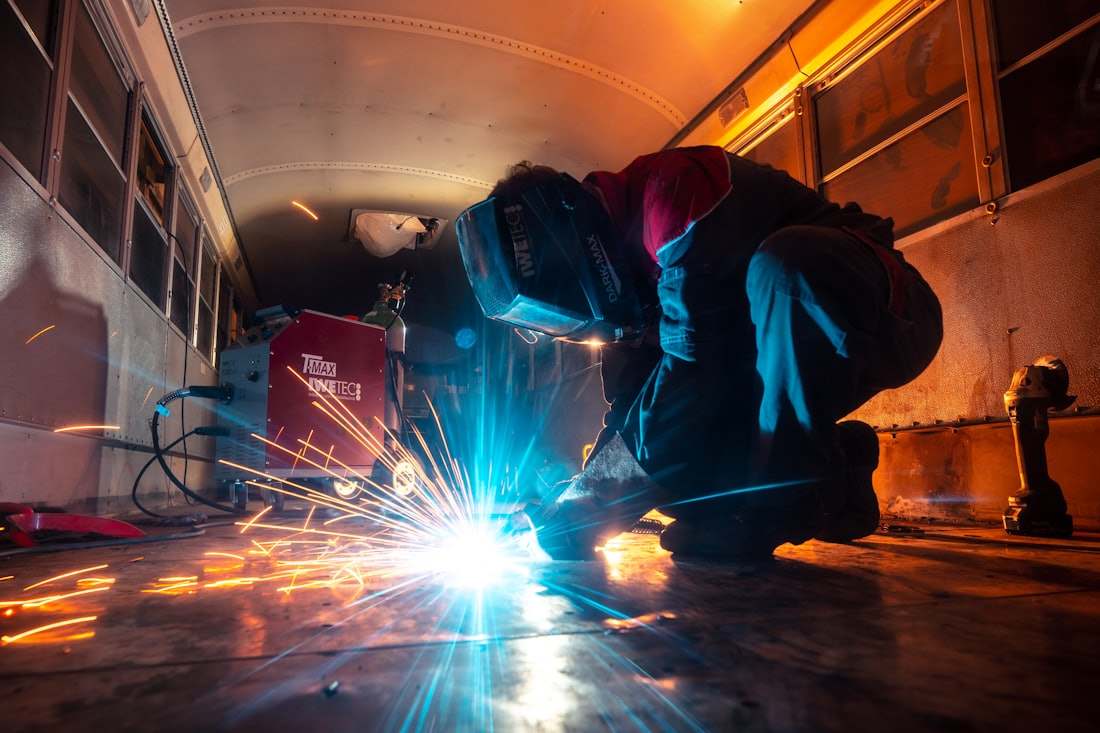
Aluminium welding joins cut and bent aluminium parts into frames, tanks, enclosures and brackets using AC TIG (argon) for thin sheet and visible seams, or pulsed MIG for thicker plate and long structural welds. Weldable alloys are the 5000 series (5754, 5083, 5052) and the 6000 series (6061, 6082); 7075 and 2024 are not welded. On CutLinq you upload a STEP assembly with weld callouts and receive a binding quote within 12 hours from a workshop in Egypt, the UAE or Saudi Arabia.
This page explains which alloys and filler wires match, how much strength is lost in the heat-affected zone, what distortion to expect and how to design joints so the welder can reach them and the part stays flat.
Alloys, fillers and strength after welding
Aluminium welds are only as strong as the heat-affected zone. Non-heat-treatable 5000 alloys lose the work hardening from rolling but keep most of their strength; 6061-T6 loses 40 to 50% of its tensile strength within 25 mm of the weld and cannot be restored without a full T6 heat treatment, which is rarely practical on a fabrication. Design 6061 frames so the welds are away from the highest stress or size the section for the as-welded value.
Filler ER5356 (AlMg5) is the general choice for 5000 alloys and for 6061 where the part will be anodised. ER4043 (AlSi5) flows better, reduces cracking on 6061 and 6082, but anodises grey and is weaker.
| Base alloy (EN / common) | Filler wire | Tensile strength before weld | As-welded tensile (HAZ) | Anodising colour match | Notes |
|---|---|---|---|---|---|
| EN AW-5754 (AlMg3) | ER5356 | 190 to 240 MPa | 180 to 200 MPa | good | enclosures, general fabrication |
| EN AW-5083 (AlMg4.5Mn) | ER5183 / ER5356 | 270 to 350 MPa | 270 to 290 MPa | good | tanks, marine, trailers |
| EN AW-5052 | ER5356 | 210 to 260 MPa | 170 to 190 MPa | good | panels, ducting |
| EN AW-6061-T6 | ER4043 or ER5356 | 290 to 310 MPa | 165 to 185 MPa | ER5356 good, ER4043 grey | frames, machined parts |
| EN AW-6082-T6 | ER4043 or ER5356 | 300 to 340 MPa | 170 to 200 MPa | as above | structural, extrusions |
| EN AW-7075, 2024 | not welded | 500 to 570 MPa | cracks | n/a | bolt or rivet instead |
TIG versus MIG for aluminium
AC TIG (argon) gives full control of the puddle, a clean silver bead and no spatter, and is the process for sheet from 1 to 4 mm, visible welds, tube joints and repairs. It is slow, typically 100 to 200 mm per minute. Pulsed MIG with a push-pull or spool gun deposits three to five times faster, handles plate from 3 to 12 mm in one or two passes, and is the choice for frames, tanks and long fillet welds where appearance is secondary or the joint will be ground.
Both processes need 100% argon; helium mixes are used on plate above 10 mm. Every joint must be degreased and stainless-brushed within an hour before welding because the oxide film re-forms quickly in humid Gulf conditions.
| Criterion | AC TIG (argon) | Pulsed MIG | Typical choice |
|---|---|---|---|
| Thickness range | 0.8 to 6 mm | 3 to 12 mm (multi-pass to 25 mm) | TIG below 3 mm, MIG above 5 mm |
| Travel speed | 100 to 200 mm/min | 400 to 800 mm/min | MIG for long welds |
| Bead appearance | stacked, uniform, no spatter | smooth with light spatter | TIG for visible seams |
| Distortion on 2 mm sheet | moderate | high | TIG with tack sequence |
| Relative cost per metre, 3 mm fillet | 1.0 | 0.4 to 0.6 | MIG on 3 mm or thicker when appearance is not critical |
| Leak-tight tanks | yes, single pass | yes with root control | either, pressure test after |
Distortion and tolerances
Aluminium expands twice as much as steel per degree and conducts heat five times faster, so distortion is the main problem. A 1000 mm long 3 mm sheet box welded on one side will bow 2 to 4 mm without fixturing. Workshops in the CutLinq network use tack sequences, back-step welding, copper backing bars and weld fixtures to hold flatness. Realistic tolerances on a welded aluminium assembly are ±1 mm on overall dimensions up to 1000 mm and ±1.5 mm up to 2000 mm; machined features after welding hold ±0.1 mm.
| Assembly size | Overall dimension tolerance | Flatness | Squareness | How to tighten |
|---|---|---|---|---|
| up to 500 mm | ±0.5 to ±0.8 mm | 1 mm | ±0.5 mm | fixture, symmetric welds |
| 500 to 1000 mm | ±1.0 mm | 2 mm | ±1.0 mm | fixture, back-step sequence |
| 1000 to 2000 mm | ±1.5 mm | 3 mm | ±1.5 mm | machine mating faces after welding |
| over 2000 mm | ±2.0 mm | 4 mm | ±2.0 mm | bolted sub-frames instead of one weldment |
Designing joints for aluminium
Fillet welds on corner joints are cheapest and strongest per unit of weld metal. Butt welds on sheet under 3 mm need close fit-up (gap under 0.5 mm) or they burn through. Give the welder access from at least one side with a 45° clear cone; a torch cannot reach inside a closed box narrower than 60 mm. Intermittent welds (for example 30 mm weld, 70 mm gap) reduce heat input and distortion on non-structural seams.
Because the heat-affected zone is weak on 6061, put bolt holes and load points at least 30 mm from any weld, or bolt through a 5754 gusset welded to the frame.
- Fillet weld leg: 0.7 to 1.0 times the thinner member, minimum 3 mm
- Butt joint gap: 0 to 0.5 mm on sheet, 1 to 2 mm with backing on plate over 6 mm
- Bevel plate over 6 mm to 60° V for full penetration
- Tube to tube: cope the tube (fishmouth) with tube laser so fit-up gap stays under 0.5 mm
- Keep welds 30 mm or more from machined bores and threads on 6061
- Specify weld symbols to ISO 2553 with length and pitch for intermittent welds
Finishing after welding
TIG welds on 5754 and 5083 anodise close to the parent colour when ER5356 filler is used; MIG welds ground flush and anodised show a slightly lighter band. Powder coating 60 to 120 µm hides all weld colour differences and is the usual finish for outdoor frames in Saudi Arabia and the UAE. Tanks and food equipment are pickled and passivated, then pressure tested to 1.5 times working pressure or dye-penetrant checked on request.
Design tips
- Choose 5754 or 5083 for welded structures; use 6061-T6 only where machined features are needed, and size it for 170 MPa as-welded.
- Keep bolt holes and load points at least 30 mm from any weld on 6000 series alloys.
- Specify ER5356 filler if the part will be anodised; ER4043 turns grey.
- Use intermittent welds of 30 mm every 100 mm on non-structural seams to cut distortion and cost by about 40%.
- Design corner joints as fillets with a 3 to 5 mm leg rather than butt welds on sheet under 3 mm.
- Provide torch access with a 45° clear cone and at least 60 mm opening for any internal weld.
- Machine mating faces, bores and dowel holes after welding, not before, and note this on the drawing.
Applications
| Industry | Example parts | Typical material |
|---|---|---|
| Solar mounting | tracker torque tube brackets, module frames | EN AW-6082-T6, 5754 |
| Marine and automotive | fuel and water tanks, trailer frames, deck fittings | EN AW-5083, 5754 |
| HVAC | fan housings, damper frames, plenums | EN AW-5052, 5754 |
| Electrical enclosures | outdoor cabinets, heat sink assemblies | EN AW-5754, 6061-T6 |
| Food and beverage | hoppers, chutes, light frames | EN AW-5754, 5083 |
| Furniture and fit-out | table frames, display stands, lighting rigs | EN AW-6060, 6082 |
| Machinery and OEM | guards, machine bases, gantries | EN AW-6082-T6, 5083 |
Pricing and lead time
Three factors drive the price of an aluminium weldment: weld length and process (TIG costs roughly 2 to 2.5 times MIG per metre), fixturing and distortion control (a flat or square tolerance under 1 mm needs a fixture that is quoted once per batch), and preparation (degreasing, brushing, bevelling above 6 mm, and post-weld machining). A 500 x 300 x 200 mm 3 mm 5754 box with 1.5 m of TIG weld serves as a reference of 1.0; the same box MIG welded costs 0.6 to 0.7, and in 1.4301 (304) stainless with TIG about 1.2 to 1.4 because stainless is slower to cut but easier to weld. Ordering 10 instead of 1 reduces unit price by 25 to 35% once the fixture exists. Lead time is 4 to 7 working days for cut, bent and welded assemblies, plus 3 to 5 working days for powder coating or anodising. Delivery in Cairo, Dubai, Sharjah, Riyadh and Dammam is next day for parts under 30 kg and 1 to 2 days by pallet; WhatsApp support shares fit-up photos before final welding if requested.
Frequently asked questions
Yes, 6061-T6 welds with ER4043 or ER5356, but the zone within 25 mm of the weld drops to roughly 165 to 185 MPa, about 40% below the T6 value. Design for that or use 5083 where full strength matters.
Upload your STEP assembly with weld callouts and receive a binding aluminium welding quote within 12 hours.