Aluminium Bending
Press-brake bending of 5052, 5754, 6061 and 6082 sheet: bend radii, cracking limits, springback and tolerances
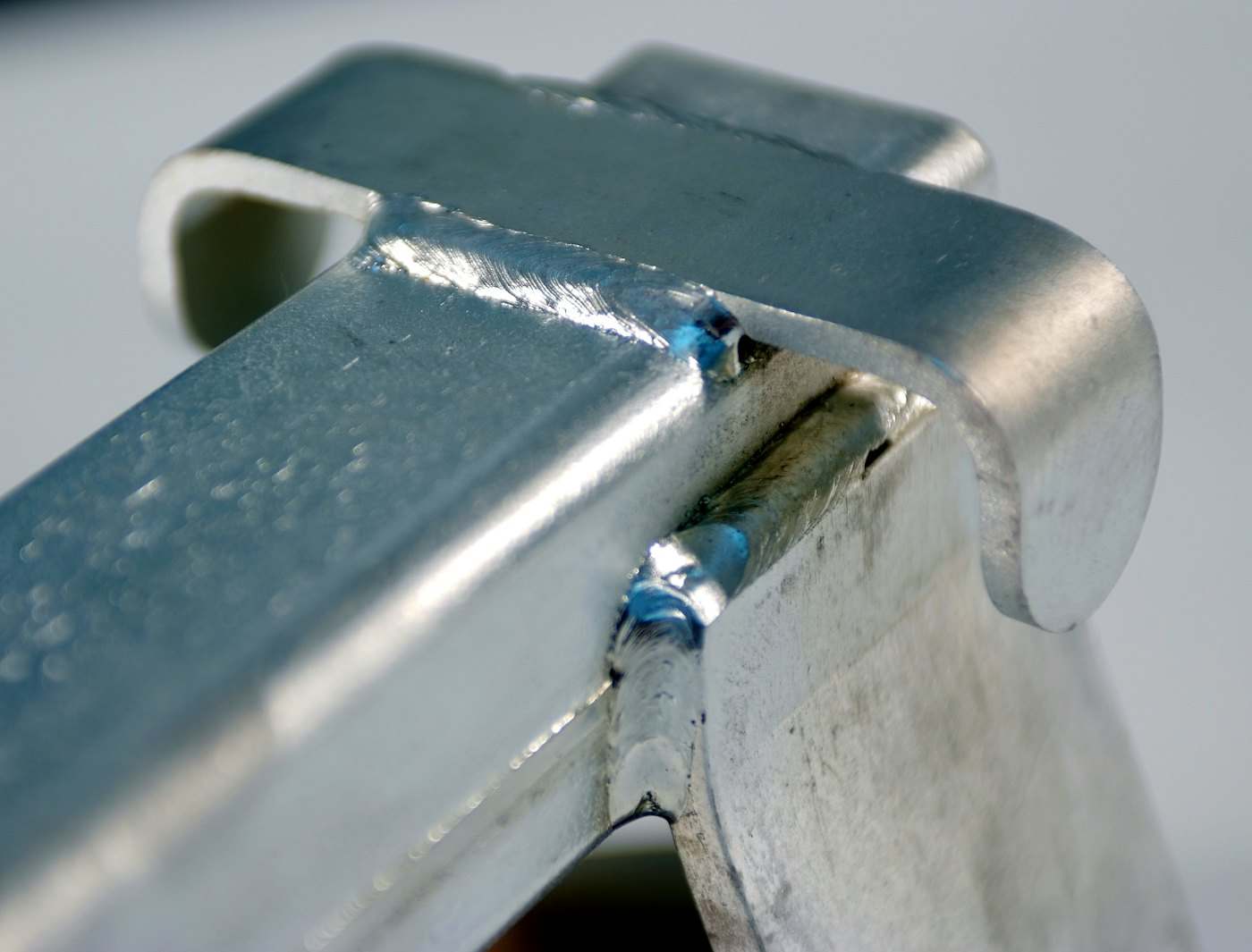
Aluminium bending is press-brake forming of aluminium sheet from 0.8 to 12 mm into brackets, enclosures, panels and channels. The process is the same as for steel, but the alloy and temper decide whether the bend succeeds: EN AW-5754 and 5052 in H22 or H32 temper bend to a tight 1t inner radius without cracking, while 6061-T6 and 6082-T6 need 2.5t to 3t and still show orange-peel or cracks along the grain if bent too tight. Angle tolerance is ±0.5° standard and ±0.25° on parts under 500 mm.
Suppliers in the CutLinq network in Egypt, the UAE and Saudi Arabia bend aluminium on CNC press brakes from 40 to 220 tonnes with 3 m and 4 m beds. Upload a DXF flat pattern or a STEP of the bent part and receive a binding quote within 12 hours.
Which alloys bend, and how tight
The 5000 series (5052, 5754, 5083) is the sheet metal family: medium strength, excellent corrosion resistance and good bendability in the H22, H32 and H111 tempers. The 6000 series (6061, 6082) is a machining and structural family; in the T6 temper it is strong but has only 8 to 12% elongation, so it cracks on tight bends. If a part must be 6061 and bent, ask for T4 temper or O (annealed) material and accept lower strength, or increase the radius. EN AW-1050 (pure aluminium) bends to 0.5t but is too soft for most structural parts.
Bends parallel to the rolling direction crack sooner than bends across it; on 6061-T6 this alone can make the difference between a good part and a scrapped one, so the flat pattern should be nested with bend lines across the grain where the sheet size allows.
| Alloy and temper | Min inner radius (thin, up to 3 mm) | Min inner radius (4 to 6 mm) | Typical use |
|---|---|---|---|
| EN AW-1050A H14 | 0.5t | 1t | Signage, decorative panels |
| EN AW-5052 / 5754 H22, H32 | 1t | 1.5t | Enclosures, brackets, marine parts |
| EN AW-5083 H111 | 1.5t | 2t | Tanks, boat structures |
| EN AW-6061 / 6082 T4 | 1.5t | 2t | Structural parts to be aged after bending |
| EN AW-6061 / 6082 T6 | 2.5t to 3t | 3t to 4t | Machined plate brackets, avoid bending |
Springback and angle control
Aluminium springs back more than steel because its elastic modulus is a third of steel's: 2 to 4° on 5754 and 4 to 8° on 6061-T6, increasing with radius. CNC press brakes with angle measurement correct this automatically on the first part; without it the operator over-bends by test. Bottoming (pressing the sheet into the V die at high tonnage) reduces springback but is limited to about 4 mm thickness in aluminium and marks the sheet.
The V-die width sets the minimum flange and the inner radius: a 6t to 8t V gives an inner radius close to 1t in soft tempers; wider dies give larger radii and less cracking. Both are chosen by the supplier from the drawing, so the drawing must state the radius you need.
| Characteristic | Standard | Achievable |
|---|---|---|
| Bend angle | ±0.5° | ±0.25° (angle-measuring brake) |
| Flange length | ±0.3 mm | ±0.15 mm |
| Inner radius | ±0.3 mm | ±0.15 mm with matched tooling |
| Flatness after bending, per 300 mm | 0.5 mm | 0.2 mm |
| Minimum flange (V = 6t to 8t) | 4t + radius | 3t with special tooling |
Surface protection during bending
Aluminium marks easily. Soft 5000-series sheet picks up die marks along the bend line, and pre-anodised or brushed sheet scratches on the die shoulders. Suppliers use polyurethane film on the sheet, plastic-coated or roller dies, and keep protective PVC film on until after bending. If a part will be anodised after bending, ask for a 0.5 mm larger radius than the minimum; micro-cracks on the outer radius show clearly through anodising.
Powder coating hides light die marks up to about 20 µm depth; anodising hides nothing. For panels in Gulf sun and dust, a brushed 5754 panel with clear anodising to 15 to 20 µm holds up better than paint.
- Keep PVC film on during cutting and bending, remove after coating only if compatible
- Polyurethane film or plastic-coated dies for pre-finished and brushed sheet
- Radius 0.5 mm above minimum for parts to be anodised
- Bend across grain wherever possible on 6000-series
Regional demand and applications
In the UAE and Saudi Arabia, most aluminium bending is for architectural cladding, signage cabinets, solar panel brackets and lighting housings, usually in 5754 H22 or 5052 H32 from 1.5 to 3 mm with powder coating or anodising for salt air and heat. In Egypt, HVAC diffusers, kitchen equipment trim and electrical enclosures dominate, mostly 1050 and 5052 in 1 to 2 mm. Marine parts around Jeddah and Dubai use 5083 in 3 to 6 mm.
Files to send
A STEP file of the finished bent part is the most reliable input; the supplier unfolds it with their own K-factor (about 0.40 to 0.45 for aluminium at 1t radius). If you send a DXF flat pattern, also send a PDF showing bend lines, bend direction (up or down), angle and inner radius, and state the alloy, temper and thickness. Mark which face is cosmetic.
Design tips
- Specify 5754 H22 or 5052 H32 for any bent aluminium part unless machining or strength forces 6061.
- Use an inner radius of 1t on 5000-series and 3t on 6061-T6; write the radius on the drawing.
- Keep the minimum flange length at 4 times thickness plus the inner radius (for example 10 mm on 2 mm sheet).
- Place holes at least 2.5t plus the bend radius from the bend line to avoid oval holes.
- Add bend relief cuts of 0.8 mm width and t plus radius depth at every flange intersection.
- Orient bend lines across the rolling direction on 6000-series and note grain direction on the drawing.
- Tolerance angles at ±0.5° and flanges at ±0.3 mm unless the assembly needs tighter; tighter costs 20 to 40% more.
Applications
| Industry | Example parts | Typical material |
|---|---|---|
| Signage and architecture | Letter cans, cladding cassettes, sun louvres | EN AW-5754 H22 1.5 to 3 mm, 1050A |
| Solar | Panel clamps, rail brackets, junction box mounts | EN AW-5052 H32 2 to 4 mm |
| Lighting | Luminaire housings, reflectors, heat-sink covers | EN AW-1050A, 5754 1 to 2 mm |
| Electronics and enclosures | Chassis, 19-inch panels, cable trays | EN AW-5052 H32 1.5 to 3 mm |
| HVAC | Diffusers, grilles, drip trays | EN AW-1050A, 5052 1 to 1.5 mm |
| Marine and transport | Hatches, brackets, bus interior trim | EN AW-5083 H111 3 to 6 mm |
| Machinery | Guards, covers, machine doors | EN AW-5754, 6082-T4 2 to 5 mm |
Pricing and lead time
Aluminium bending is priced on three factors: the number of bends per part (each bend is one machine stroke plus handling, so a 12-bend enclosure costs several times a 2-bend bracket), sheet thickness and alloy (thicker and T6 material needs larger tooling and more care, and 5754 sheet costs roughly 2 to 2.5 times mild steel), and surface protection requirements (film, coated dies and cosmetic handling add 10 to 25%). Simple cut-and-bend parts from stock 5754 or 5052 sheet ship in 4 to 7 working days; parts with anodising or powder coating add 5 to 8 working days.
Frequently asked questions
T6 temper has only 8 to 12% elongation. At 1t radius, especially along the rolling direction, the outer fibre exceeds that and cracks. Use 3t radius, switch to 5754 H22, or bend in T4 and age afterwards.
Upload the STEP file of your bent part or a DXF with bend lines and receive a binding quote from CutLinq within 12 hours.