Waterjet Cutting
Cold cutting of metal, stone, glass and composites up to 150 mm with no heat-affected zone
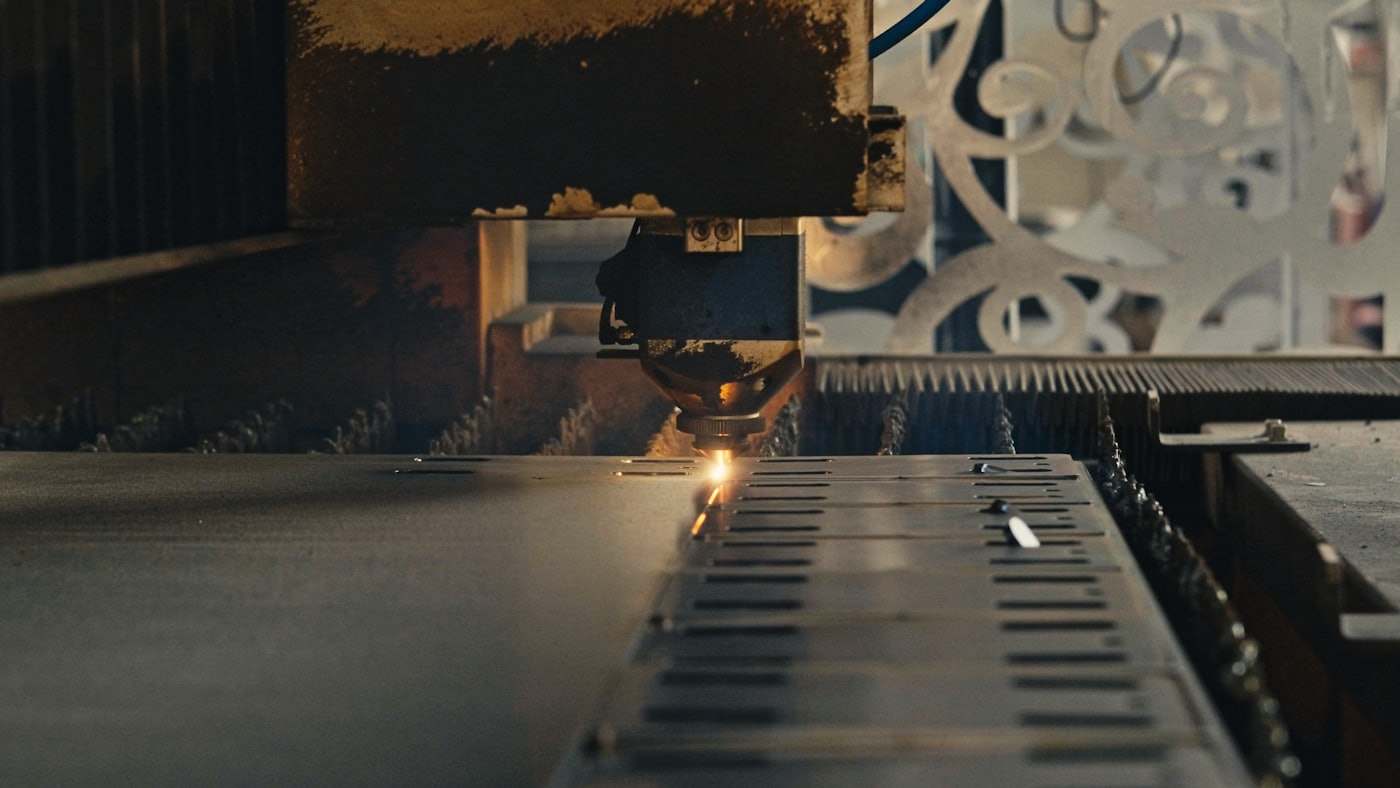
Waterjet cutting forces water at 3800 to 6000 bar through a 0.25 to 0.35 mm orifice; garnet abrasive is added to the stream to cut any material from 1 mm aluminium to 150 mm steel, granite or glass. Because the process is cold, there is no heat-affected zone, no hardening at the edge and no distortion, which is why it is chosen for tool steel, titanium, thick aluminium, laminated glass and marble. Upload a DXF file to CutLinq and receive a binding quote within 12 hours from waterjet shops in Egypt, the UAE and Saudi Arabia.
Waterjet is slower and more expensive per metre than fiber laser on sheet under 10 mm, so it is not a substitute for laser on thin steel. It wins where the laser cannot go: reflective copper over 6 mm, hardened steel, stacked sheets, materials that burn or release toxic fumes, and thick plate that must stay flat.
How abrasive waterjet cutting works
An intensifier pump raises water pressure to 4000-6000 bar. The water passes through a jewel orifice, creating a jet at roughly 900 m/s that draws garnet abrasive (mesh 80 is standard) into a mixing tube of 0.76 to 1.0 mm bore. The abrasive does the cutting by erosion. Pure water without abrasive is used for foam, rubber, gaskets and food products.
The cutting table is typically 2000 x 3000 mm or 3000 x 4000 mm and the part sits on slats above a water tank. Modern heads tilt up to 5° to compensate the natural taper of the jet, giving near-vertical edges on parts up to 50 mm.
Materials and thickness range
Almost any solid material can be cut. The practical limit is cutting speed: 100 mm stainless cuts at 10-20 mm/min, so thick parts are priced by the hour rather than by the metre.
| Material | Grade examples | Practical range | Maximum | Speed at 10 mm |
|---|---|---|---|---|
| Mild and structural steel | S235JR, S355JR | 3-100 mm | 150 mm | 250-350 mm/min |
| Stainless steel | 1.4301 (304), 1.4404 (316L) | 3-100 mm | 150 mm | 220-300 mm/min |
| Aluminium | EN AW-5754, 6061-T6, 7075 | 3-120 mm | 150 mm | 600-900 mm/min |
| Titanium | Grade 2, Grade 5 | 3-80 mm | 100 mm | 200-280 mm/min |
| Tool steel, hardened | 1.2379, 42CrMo4 | 5-80 mm | 100 mm | 200-260 mm/min |
| Copper and brass | Cu-ETP, CuZn37 | 3-60 mm | 80 mm | 350-500 mm/min |
| Marble, granite, ceramic | - | 10-60 mm | 100 mm | 300-600 mm/min |
| Glass, laminated glass | - | 4-30 mm | 50 mm | 400-800 mm/min |
Tolerance, taper and edge quality
Waterjet edges are matte and slightly sandblasted in appearance. Quality is specified in five grades: Q1 is a fast separation cut with visible striations, Q5 is a slow finish cut with Ra 3-4 µm. Most engineering parts are ordered at Q3. Tolerance depends on thickness and quality grade rather than on the machine itself.
| Thickness | Kerf width | Tolerance at Q3 | Taper without tilt head | Edge roughness Q3 |
|---|---|---|---|---|
| 1-10 mm | 0.8-1.0 mm | ±0.1 mm | 0.05-0.1 mm | Ra 4-6 µm |
| 10-30 mm | 0.9-1.1 mm | ±0.15 mm | 0.1-0.3 mm | Ra 6-10 µm |
| 30-80 mm | 1.0-1.3 mm | ±0.25 mm | 0.3-0.8 mm | Ra 10-16 µm |
| 80-150 mm | 1.2-1.5 mm | ±0.5 mm | 0.8-1.5 mm | Ra 16-25 µm |
When to choose waterjet instead of laser or plasma
Choose waterjet when the material is thicker than the laser limit (25 mm steel, 20 mm stainless, 15 mm aluminium), when heat would change the material properties, or when the material is not metal. Hardened tool steel blanks, titanium implants, aluminium 7075 fixture plates over 20 mm and marble inlays for hotel lobbies in Dubai and Riyadh are typical waterjet jobs.
Choose fiber laser for sheet under 10 mm where speed and cost matter, and plasma for structural steel 10-50 mm where ±1 mm is acceptable. A 20 mm S355JR flange with bolt holes costs roughly 3 to 4 times more on waterjet than on plasma, but arrives without the hardened edge that makes drilling plasma-cut holes difficult.
Regional considerations
Waterjet capacity in the region is concentrated in Cairo (Abu Rawash, 10th of Ramadan), Dubai (Al Quoz, DIP), Sharjah and Riyadh. Stone and glass cutting for interior fit-out is a large share of the work, so metal jobs should specify the quality grade and tolerance clearly to be quoted correctly. Garnet abrasive is imported and its price moves with freight cost, which is one reason waterjet quotes vary more than laser quotes.
- Specify Q3 for engineering parts, Q4-Q5 for visible edges, Q1-Q2 for parts that will be machined afterwards
- Ask for a tilt head (taper compensation) on parts over 30 mm that need parallel edges
- Allow 1.0-1.5 mm kerf in nesting; small inner holes below 2 mm are not possible
- Thick parts can be delivered with a 3-5 mm machining allowance for finish milling
Design tips
- Minimum inner hole diameter is 2 mm on thin material and 1 x thickness on plate over 20 mm; drill smaller holes afterwards.
- Keep inside corners at radius 0.5 mm or larger; a sharp corner would be rounded by the 1 mm jet anyway.
- Leave a 3-5 mm machining allowance on faces that need Ra below 3 µm or tolerance tighter than ±0.1 mm.
- Design bridges between parts of at least 3 mm on plate over 20 mm to prevent parts tipping into the tank.
- Provide the DXF at nominal dimensions; the kerf of 0.8-1.5 mm is compensated by the machine.
- State the quality grade Q1 to Q5 on the drawing; the difference between Q1 and Q5 is roughly 3 times the cutting time.
- For stacked cutting of thin sheets, limit the stack to 25 mm total and expect ±0.2 mm on the bottom sheet.
Applications
| Industry | Example parts | Typical material |
|---|---|---|
| Tooling and machinery | Die blanks, fixture plates, wear plates | 1.2379, 42CrMo4 20-80 mm |
| Oil and gas | Thick flanges, blind plates, spacer rings | S355JR, 1.4404 (316L) 30-100 mm |
| Aerospace and medical | Titanium brackets, implant blanks | Ti Grade 5 5-30 mm |
| Architecture and fit-out | Marble inlays, glass panels, decorative screens | Granite 20-30 mm, 1.4301 (304) 3-10 mm |
| Electrical | Thick busbars, transformer parts | Cu-ETP 10-40 mm |
| Automotive and racing | Aluminium chassis plates, spacers | 6061-T6, 7075 10-50 mm |
| Rubber and gaskets | Seals, insulation, foam packaging | Rubber, foam 2-50 mm, pure water |
Pricing and lead time
Waterjet pricing is driven by machine time (thickness, material hardness and quality grade set the cutting speed), abrasive consumption (0.3 to 0.5 kg per minute of cutting, about a third of the running cost) and material cost, which is significant on thick titanium, tool steel or stainless plate. A 40 mm stainless part costs roughly 4 to 5 times more per metre of cut than 10 mm aluminium. Lead time is 3 to 5 working days for standard jobs in Cairo, Dubai and Riyadh, 5 to 10 working days for thick plate over 60 mm or non-stock material. Local delivery is same or next day for parts under 30 kg; heavy plates ship on pallets within 1-2 days.
Frequently asked questions
No. The cut is cold, so hardened 1.2379 or 42CrMo4 keeps its heat treatment right up to the edge. This is the main reason to choose waterjet over laser or plasma for tooling blanks.
Upload your DXF or STEP file to CutLinq and receive a binding waterjet cutting quote within 12 hours.