What Drives Laser Cutting Cost
Material, thickness, cut length and nesting are the four levers that set a laser-cut part's price
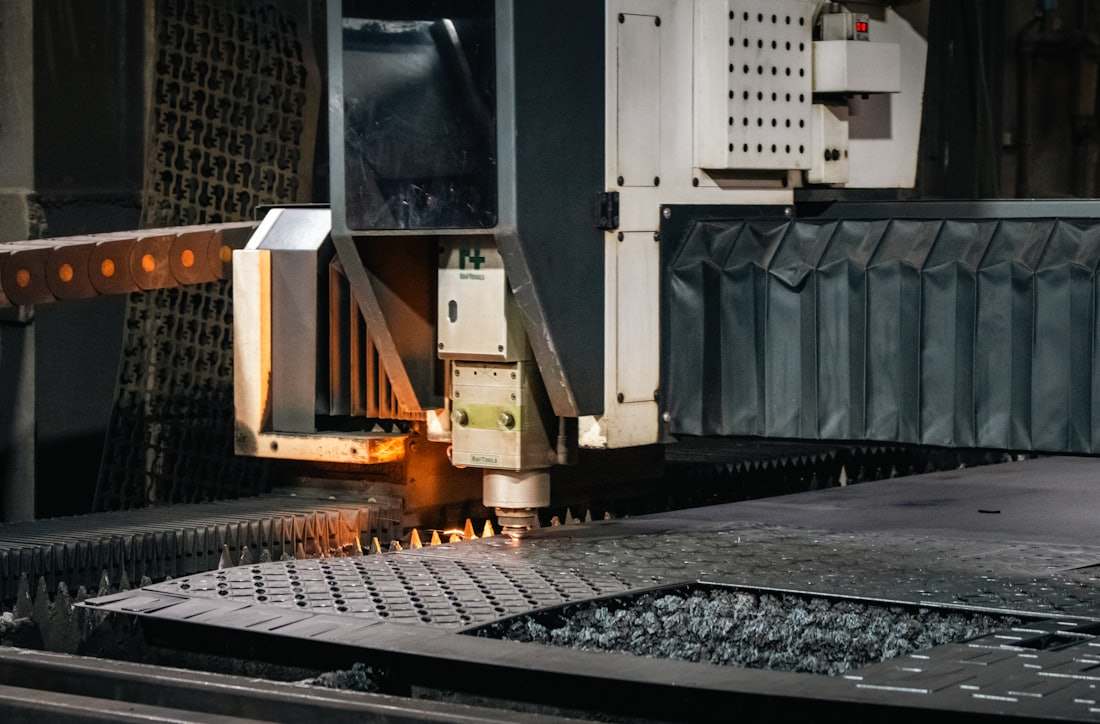
Laser cutting cost is set by four factors: material type and thickness (thicker material cuts slower and costs more per kilogram), total cut length (perimeter and hole count, since the laser head must traverse every edge), sheet nesting efficiency (how much of the raw sheet ends up as scrap), and order quantity. A part with many small holes can cost more to cut than a larger part with a single simple outline.
Fiber lasers commonly used in the region cut mild steel up to 25 mm, stainless steel up to 20 mm, and aluminium up to 15 mm, with cutting speed dropping sharply as thickness increases.
Material and thickness
Cutting speed drops as thickness increases: a fiber laser cuts 2 mm mild steel many times faster than 12 mm mild steel, so machine time per metre of cut rises steeply with thickness. Reflective materials such as aluminium and copper alloys also cut slower than mild steel at equivalent thickness due to how the material absorbs laser energy.
As a rough guide, cutting 316L stainless costs roughly 20-30% more than mild steel at the same thickness, and aluminium above 10 mm becomes noticeably slower to cut than mild steel of the same thickness.
| Material | Max practical thickness (fiber laser) | Relative cut speed |
|---|---|---|
| Mild steel S235JR | up to 25 mm | baseline |
| Stainless 316L (1.4404) | up to 20 mm | 10-20% slower |
| Aluminium 5754/6061 | up to 15 mm | 15-30% slower above 8 mm |
Cut length and hole count
Total price scales with the length the laser head must travel, which includes the outer perimeter, every internal hole, and every slot. A plate with 50 small holes can take longer to cut, and cost more, than a plain plate twice its size with only an outer outline.
Piercing time also adds up: each pierce (the moment the laser starts a new cut, such as entering a hole) takes a fraction of a second to several seconds depending on thickness, so a design with many separate features accumulates pierce time on top of cut length.
Sheet nesting and material yield
Parts are nested (arranged) on a standard sheet to minimise offcut waste. A single part cut from a full sheet might use only 20-30% of the material, with the rest scrapped; nesting many identical or complementary parts on one sheet can push utilisation above 80%, directly lowering the material cost allocated to each part.
Irregular part shapes with awkward angles nest less efficiently than rectangular or simple curved shapes, which is one reason two parts of similar size can have different per-part material cost.
| Nesting scenario | Typical material utilisation |
|---|---|
| Single part per sheet | 20-30% |
| Small batch, similar parts | 50-65% |
| Large batch, optimised nest | 75-85% |
Worked example
A 3 mm mild steel plate, 300 x 200 mm, with a simple outer outline and 4 holes costs a baseline amount X to cut at quantity 1. The same plate in 316L stainless costs roughly 1.15-1.2X due to slower cutting. Ordering 50 of the same part, nested efficiently on shared sheets, can drop the per-part price to roughly 0.4-0.5X of the single-part price, combining setup amortisation with better material yield.
Design tips
- Keep hole diameters at or above material thickness to avoid slow, taper-prone small-hole cutting.
- Combine or simplify closely spaced holes where the design allows, to reduce total pierce count.
- Choose standard sheet-friendly part dimensions where possible to improve nesting yield.
- Batch identical parts together; nesting efficiency improves sharply above roughly 10-20 pieces.
- Specify 316L stainless only where corrosion resistance is genuinely required, given the 10-20% cost premium over mild steel.
- Avoid unnecessarily thick material; going from 4 mm to 6 mm can add 20-40% to cut time for the same outline.
- Group parts sharing material and thickness into one order to nest across a shared sheet.
Applications
| Industry | Example parts | Typical material |
|---|---|---|
| Electrical | Panel plates, brackets | Mild steel, 304 stainless |
| HVAC | Duct flanges, brackets | Galvanised steel DX51D |
| Signage | Facade panels, letters | Aluminium 5754 |
| Machinery OEM | Guards, mounting plates | S235JR |
| Solar | Mounting brackets | Galvanised steel, aluminium |
| Construction | Gusset plates, brackets | S235JR, S355 |
Pricing and lead time
Laser cutting cost is driven by three factors: material grade and thickness, total cut length and pierce count, and nesting efficiency at the given order quantity. Lead time for standard laser-cut parts runs 2-4 working days; parts needing bending or finishing add 1-4 working days depending on the process.
Frequently asked questions
Price scales with total cut length and the number of pierces, not just part size, so many small holes add cut time and piercing time that a plain outline does not have.
Upload a DXF file with your material and thickness to receive a binding quote within 12 hours.