Tube and Profile Laser Cutting
Fiber laser cutting of round, square and rectangular tube, angle and channel with holes, slots and mitres in one pass
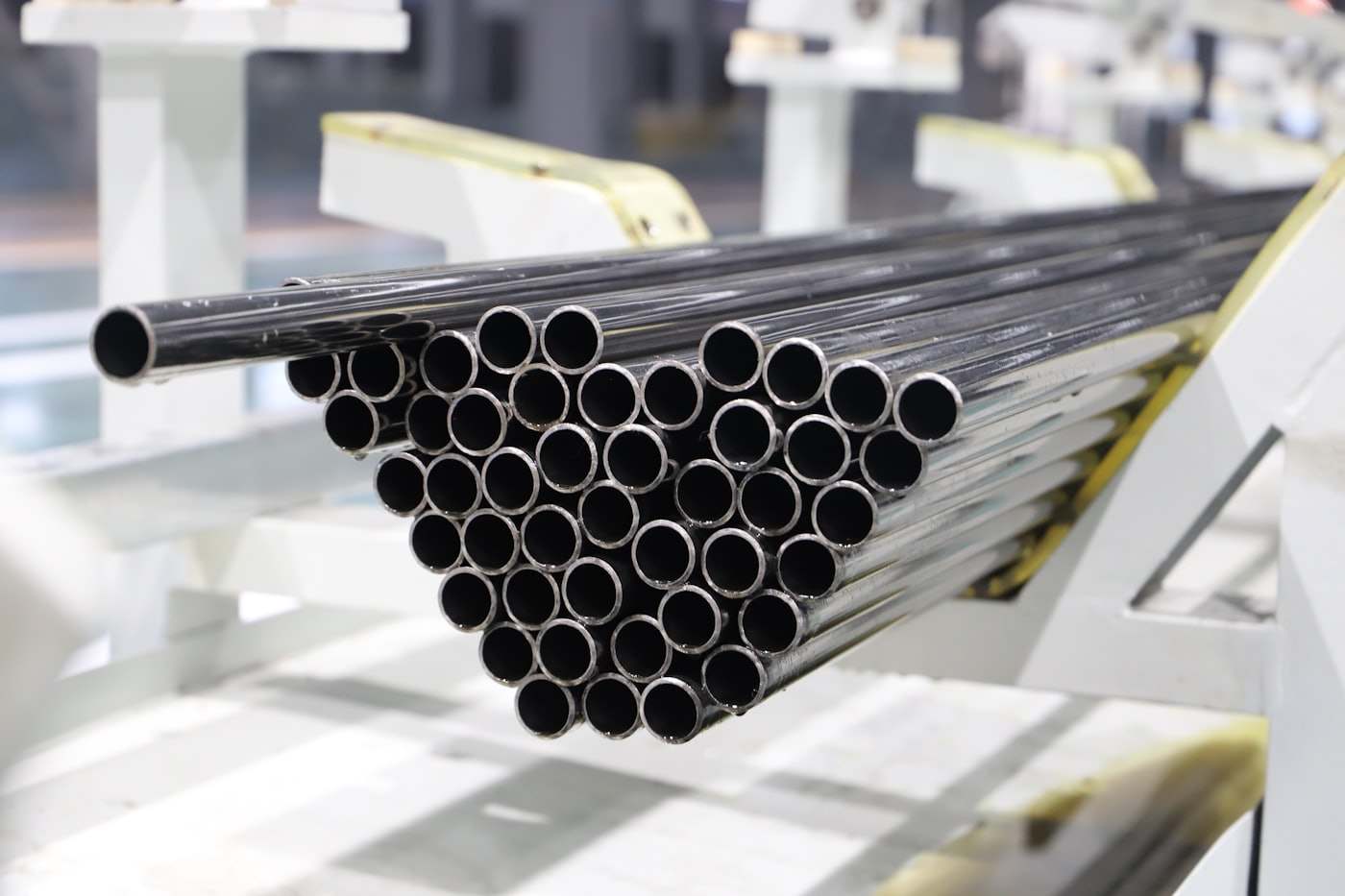
Tube laser cutting uses a fiber laser mounted on a rotary chuck to cut holes, slots, notches, mitres and copes into round, square, rectangular and oval tube, as well as angle, channel and other open profiles. The tube rotates and feeds while the head cuts, so every feature is produced in one clamping. Typical range is 12 to 250 mm diameter (or diagonal) and 0.8 to 12 mm wall thickness in mild steel, stainless steel and aluminium, with positional accuracy of about ±0.1 mm.
Compared with sawing, drilling and milling the same tube, the laser removes three or four setups and delivers self-locating joints (tab and slot, interlocking mitres) that shorten welding time. CutLinq places tube laser jobs with suppliers in Egypt, the UAE and Saudi Arabia. Upload a STEP file and receive a binding quote within 12 hours.
Profiles, materials and size limits
Most tube lasers in the region are 2 to 4 kW fiber machines with a 6 or 6.5 m loader and a 150 to 250 mm chuck. Round, square and rectangular tube are standard; angle, channel, flat bar and some I-sections are cut on machines with open-profile support. Heavier hot-rolled sections above 12 mm wall are sawn and plasma-cut instead.
Material grades commonly stocked: S235JR and S355J2 for structural tube (EN 10219 / EN 10210), E235 precision tube (EN 10305), 1.4301 (304) and 1.4404 (316L) stainless in welded tube, and EN AW-6060/6063-T6 and 6061-T6 aluminium extrusions. Galvanised tube (DX51D+Z or hot-dip after cutting) can be cut but zinc fume extraction and slight edge spatter should be expected.
| Material | Wall thickness (mm) | Outer size (mm) | Cut tolerance |
|---|---|---|---|
| Mild steel S235JR / S355J2 | 0.8 to 12 | 12 to 250 dia. or diagonal | ±0.1 to ±0.2 |
| Stainless 1.4301 (304) / 1.4404 (316L) | 0.8 to 8 | 12 to 220 | ±0.1 to ±0.2 |
| Aluminium 6060 / 6061-T6 | 1.0 to 6 | 15 to 200 | ±0.15 to ±0.25 |
| Galvanised DX51D+Z | 1.0 to 4 | 15 to 150 | ±0.15 |
Features that replace secondary machining
A tube laser cuts the whole feature list of a welded frame in one program: bolt holes, slotted holes, rectangular cut-outs for cross members, 45° mitres at corners, saddle copes where a round tube meets another round tube, and tab-and-slot joints that let the welder assemble the frame without a jig. Length is cut in the same cycle, so parts arrive ready to weld.
Bevel-capable heads (up to 45°) can put weld preparations on the tube end. Marking with low power is used for part numbers or bend lines, which is useful on frames with many similar members.
- Holes from 1x wall thickness minimum; use 1.5x for clean round holes above 3 mm wall
- Slots minimum width 1x wall thickness, no maximum length
- Mitres 0 to 45° on square and rectangular tube; compound mitres on 3D machines
- Saddle copes on round tube for T and K joints with 0.5 to 1 mm root gap
- Tab and slot: tab 1.5x wall long, slot 0.1 to 0.2 mm wider than tab thickness
- Engraved part numbers or bend marks at no extra setup
Tolerances and straightness
Feature position along the tube is typically held to ±0.2 mm over 1 m and ±0.5 mm over 6 m, limited more by the raw tube than the machine. Commercial tube has straightness of 1 to 2 mm per metre and outer dimension tolerance of ±0.5% (EN 10219), so a hole 3 m from the end cannot be more accurate than the tube it sits on. If a frame needs tight geometry, specify precision tube (EN 10305) or add 0.5 mm clearance to mating holes.
Twist on square and rectangular tube is compensated by the seam-detection camera on modern machines, but corner radius variation between batches still affects tab-and-slot fits.
| Characteristic | Typical | Achievable with precision tube |
|---|---|---|
| Hole position over 1 m | ±0.2 mm | ±0.1 mm |
| Cut length over 6 m | ±0.5 mm | ±0.3 mm |
| Mitre angle | ±0.5° | ±0.25° |
| Hole diameter | ±0.1 mm | ±0.05 mm |
| Straightness | 1.5 mm/m (raw tube) | 0.5 mm/m |
Regional considerations
Structural tube in Egypt is mostly local ERW in S235 equivalent with a mill scale that cuts cleanly; Gulf projects more often specify S355 or hot-dip galvanised finish for coastal exposure. Aluminium 6063 tube is widely used for shade structures and solar canopies in Saudi Arabia and the UAE because it tolerates salt air without coating. Delivered lengths above 6 m need special transport; most suppliers in Cairo, Dubai and Riyadh deliver 6 m bundles by flatbed and shorter cut parts by van.
What to send for a quote
Send a STEP file of each unique tube member with the profile modelled to the stock size you can buy locally (for example 40x40x2 mm, 50x50x3 mm, 60x40x2 mm, 48.3x3.2 mm round). A DXF of a flat pattern does not work for tube. Add a simple assembly drawing if members interlock, state the material grade and whether tube ends must be closed with caps or left open, and note the quantity per member.
Design tips
- Model tube to a standard stock size (40x40x2, 50x50x3, 60x60x3, 80x40x3 mm); non-stock sizes add 5 to 10 working days for material.
- Keep holes at least 1x wall thickness in diameter and 2x wall thickness from a corner radius.
- Use tab-and-slot joints with 0.15 mm clearance per side to eliminate welding jigs on frames under 3 m.
- Design mitres at 45° on square tube; add a 1 mm root gap if the joint will be fully welded.
- Leave 2 mm of uncut material between adjacent slots to avoid heat distortion on thin wall (under 1.5 mm).
- For frames longer than 3 m, tolerance the hole pattern to a datum at one end rather than both ends.
- State inner corner radius requirement only if it matters; laser leaves 0.1 to 0.3 mm radius in sharp internal corners.
Applications
| Industry | Example parts | Typical material |
|---|---|---|
| Solar mounting | Purlins, torque tube supports, canopy frames | S355J2 galvanised, EN AW-6063-T6 |
| Furniture and fit-out | Table frames, shelving, display stands | S235JR ERW tube 1.5 to 2 mm |
| HVAC | AHU frames, duct support brackets | DX51D+Z, S235JR |
| Machinery | Machine bases, conveyor frames, guarding | S235JR 3 to 5 mm, 1.4301 (304) |
| Automotive aftermarket | Roll cages, bumpers, roof racks | E235 precision tube, S355 |
| Food and pharma | Trolleys, hygienic frames, handrails | 1.4404 (316L) polished tube |
| Construction | Handrails, balustrades, staircase stringers | S235JR, 1.4301 (304) |
Pricing and lead time
Tube laser price is driven by three things: cutting time (wall thickness and total cut length per part, including every hole), material weight and grade (stainless costs roughly 3 to 4 times mild steel per kg, aluminium tube about 2.5 times), and setup per profile size (each change of tube section costs a chuck adjustment, so ten members from one section are cheaper than ten sections of one member each). Simple cut-to-length work with a few holes runs 3 to 5 working days; frames with many interlocking members, bevels or stainless finishing run 7 to 12 working days. Add 5 to 10 working days if non-stock sections must be imported.
Frequently asked questions
Yes, up to about 4 mm wall. The zinc burns back 0.5 to 1 mm around the cut and should be touched up with zinc-rich paint, or you cut black and hot-dip galvanise afterwards, which is the better option for outdoor structures.
Upload your STEP files for each tube member and receive a binding quote from CutLinq within 12 hours.