Laser Engraving and Marking
Permanent serial numbers, logos, QR codes and scales on steel, stainless, aluminium, brass and plastics
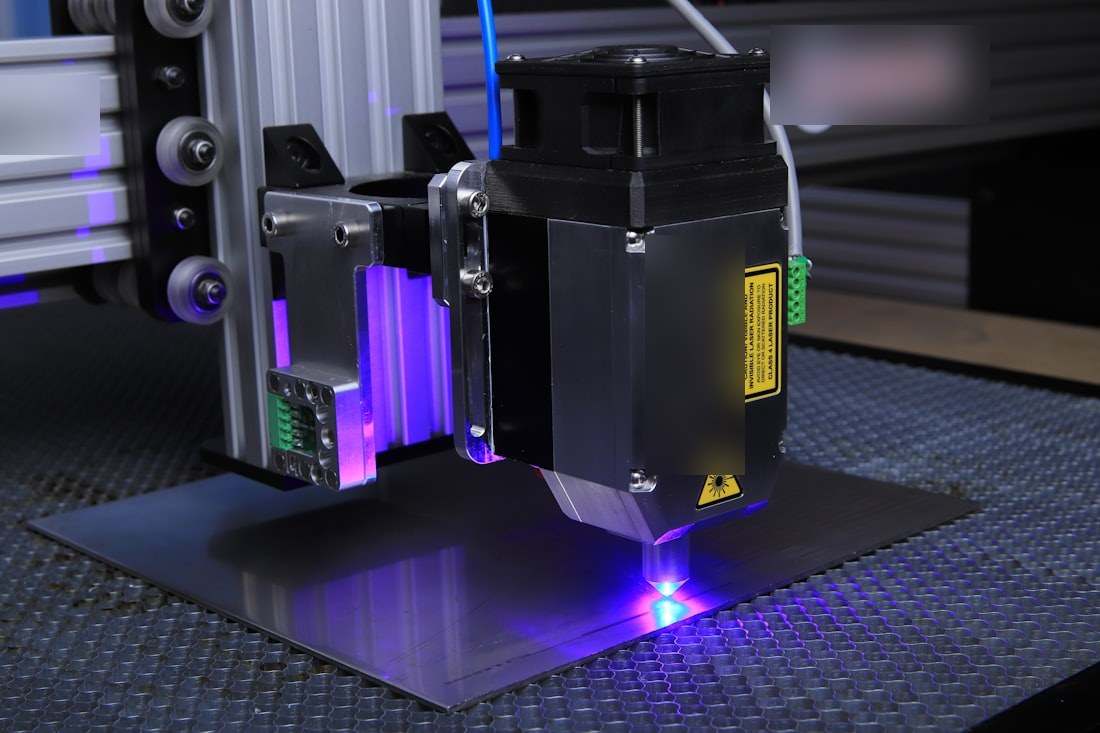
Laser engraving and laser marking put permanent text, logos, scales, data-matrix or QR codes onto metal and plastic parts without ink, labels or tooling. Marking changes the surface colour or texture at a depth of a few micrometres; engraving removes material to a depth of 0.05 to 0.5 mm. On CutLinq you add marking to a laser-cut, bent or machined part on the same order, or send finished parts for marking only. Upload a DXF or STEP file with the artwork and receive a binding quote within 12 hours.
This page covers fiber and CO2 laser marking types, which materials respond to which process, achievable line widths and depths, how to prepare artwork, and what it costs relative to the part itself.
Marking, engraving, annealing and ablation
Four processes are grouped under the same name. Surface marking melts a thin layer and leaves a light or dark contrast with no measurable depth. Annealing marking heats stainless or titanium below the melting point so a black oxide forms; the surface stays smooth and corrosion resistance is preserved, which matters for food and medical parts. Engraving vaporises material in repeated passes and leaves a groove you can feel. Ablation removes a coating, paint, anodised layer or powder coat to reveal the base metal underneath.
Choose annealing for stainless nameplates and surgical instruments, engraving for parts that will be painted or that face sand abrasion in the Gulf, and ablation for backlit control panels and anodised aluminium plates.
| Process | Depth | Contrast | Cycle time for 30 mm text | Best material |
|---|---|---|---|---|
| Surface marking | 0.001 to 0.01 mm | light or dark grey | 2 to 5 s | steel, aluminium, brass |
| Annealing marking | 0 mm (oxide only) | black | 10 to 30 s | 1.4301 (304), 1.4404 (316L), Ti Grade 5 |
| Deep engraving | 0.05 to 0.5 mm | recessed, may be paint filled | 30 to 300 s | steel, brass, aluminium |
| Ablation | coating thickness | base metal on coloured ground | 2 to 10 s | anodised aluminium, powder-coated steel |
Materials and laser type
Fiber lasers at 1064 nm mark all metals and most dark engineering plastics. CO2 lasers at 10.6 µm are used for acrylic, wood, glass and coated or anodised surfaces but do not mark bare metal. In the MENA market almost all metal marking is done with 20 to 50 W fiber sources.
Coated parts are marked after coating: powder coat 60 to 120 µm and anodising 5 to 25 µm are both removed cleanly. Zinc-plated parts should be marked before plating or the mark will re-plate over.
| Material (EN / common) | Fiber laser | CO2 laser | Typical result |
|---|---|---|---|
| S235JR, DC01 mild steel | yes | no | dark grey mark or engraving; oil after |
| 1.4301 (304), 1.4404 (316L) | yes | no | black anneal, white or dark mark |
| EN AW-5754, 6061-T6 bare | yes | no | light grey to white, lower contrast |
| Anodised aluminium | yes | yes | white or silver on colour, high contrast |
| CuZn37 brass, Cu-ETP copper | yes (higher power) | no | dark mark, slower on copper |
| Ti Grade 5 | yes | no | black or coloured anneal |
| POM, PA, ABS, PEEK | yes (dark grades) | limited | foamed light mark on dark plastic |
| PMMA acrylic | no | yes | frosted engraving |
Resolution, depth and legibility
A fiber marking head focuses to a spot of about 0.03 to 0.05 mm, so minimum line width is 0.05 mm and minimum legible character height is 0.5 mm for annealed text and 1 mm for engraved text. Data-matrix codes with 0.15 mm cell size are readable by standard scanners; for parts that will be blasted, painted or handled in dusty conditions use 0.3 mm cells.
Marking depth for durability: 0.01 mm survives handling and cleaning; 0.05 mm survives bead blasting and light powder coating if masked; 0.2 mm or more survives sand abrasion, repainting and outdoor exposure over years in Saudi Arabia and the UAE.
| Feature | Minimum | Recommended | Note |
|---|---|---|---|
| Character height | 0.5 mm | 2 to 3 mm | sans-serif fonts read best |
| Line width | 0.05 mm | 0.15 mm | thicker lines for painted parts |
| Data-matrix cell | 0.15 mm | 0.3 mm | ISO/IEC 29158 grading available on request |
| Engraving depth | 0.05 mm | 0.2 mm outdoor | each 0.1 mm adds roughly 1 to 3 passes |
| Marking area per setup | single field 100 x 100 mm | up to 300 x 300 mm with stitching | larger areas by XY table |
| Position tolerance to part edge | ±0.2 mm | ±0.1 mm with fixture | a jig is made for batches over 50 |
Preparing artwork
Send vector artwork (DXF, DWG, SVG, AI or PDF with outlines) for logos and text; raster images (PNG, JPG) are accepted for photo engraving only. Convert fonts to curves so nothing substitutes. For serial numbers send a list or a start value and count; each part receives its own number at no extra cost per variant.
Place the mark in the drawing as a separate layer named MARK and state the process (anneal, mark, engrave, ablate), depth and whether the mark should be paint filled. Note any surfaces to avoid, such as sealing faces, threads and bearing bores.
- Vector formats: DXF, DWG, SVG, AI, PDF with text converted to outlines
- Serial lists: CSV or XLSX, one number per row; date codes and shift codes can be generated
- Codes: QR, Data Matrix ECC200, Code 128; state the string and the cell size
- Position: dimension the mark to two part edges or a hole centre, not to a corner radius
- Depth: write the value in mm; 0 mm means anneal or surface mark
Marking as part of a fabrication order
Most marking on CutLinq is added to laser-cut, bent, machined or coated parts from the same quote. Marking before bending is cheaper because flat blanks are easier to fixture, but marks near the bend line (within 2 times the sheet thickness) may distort. Marking after powder coating or anodising gives the highest contrast. Batches of 50 or more receive a dedicated locating jig so every mark sits within ±0.1 mm of the drawing position.
Design tips
- Keep text height at 2 mm or more and line width at 0.15 mm or more on parts that will be handled or cleaned in dusty workshops.
- Leave a 3 mm margin between the mark and any edge, hole or bend line to avoid distortion and clamp interference.
- For outdoor nameplates in the Gulf specify engraving depth 0.2 mm and either paint fill or annealed stainless 1.4404 (316L).
- Use Data Matrix rather than QR for codes under 10 x 10 mm; it packs the same data at lower cell count.
- Mark before zinc plating and after powder coating or anodising; state the sequence on the order.
- Dimension the mark position from two datum edges with ±0.5 mm tolerance unless a scale or dial needs ±0.1 mm.
- Order marking with the part instead of separately; a second shipment and setup roughly doubles the marking cost.
Applications
| Industry | Example parts | Typical material |
|---|---|---|
| Electrical panels | front plates, terminal labels, rating plates | anodised aluminium, 1.4301 (304) |
| Machinery and OEM | serial plates, part numbers, gear marks | S235JR, 1.4301 (304) |
| Medical and laboratory | instrument identification, UDI codes | 1.4404 (316L), Ti Grade 5 |
| Oil and gas | valve tags, traceability codes, heat numbers | 1.4404 (316L), 42CrMo4 |
| Signage and interiors | logos, wayfinding, brass plaques | CuZn37, anodised aluminium |
| Automotive aftermarket | VIN-style stamps, part branding | S355J2, 6061-T6 |
| Solar and HVAC | asset tags, warning plates | 1.4301 (304), DX51D+Z |
Pricing and lead time
Three factors drive marking cost: marking time (area covered, engraving depth and number of passes), handling (whether a fixture is needed and whether parts are marked flat or after assembly), and setup (artwork preparation, serial list programming, first-article check). A single 20 x 5 mm annealed part number on a stainless bracket adds roughly 3 to 8% to the part price; a 0.2 mm deep engraved logo of 50 x 50 mm can add 20 to 40%. Serialisation costs the same per part as a fixed mark once the list is loaded. Lead time when marking is added to a fabrication order is 0 to 1 working day on top of the part; marking-only jobs on supplied parts take 1 to 3 working days. Courier delivery within Cairo, Dubai, Sharjah, Riyadh and Jeddah is usually next day, and WhatsApp support can confirm artwork proofs before the run starts.
Frequently asked questions
Annealed and engraved marks are part of the metal and survive solvents, alkaline cleaners and abrasion. Surface marks with no depth can be polished off. For sand-blown outdoor parts specify 0.2 mm engraving depth.
Upload your DXF or STEP file with the marking artwork and receive a binding quote within 12 hours.