Brass (CuZn37, CuZn39Pb3)
Laser cutting, CNC turning and milling of brass sheet, plate and bar for fittings, decorative and electrical parts
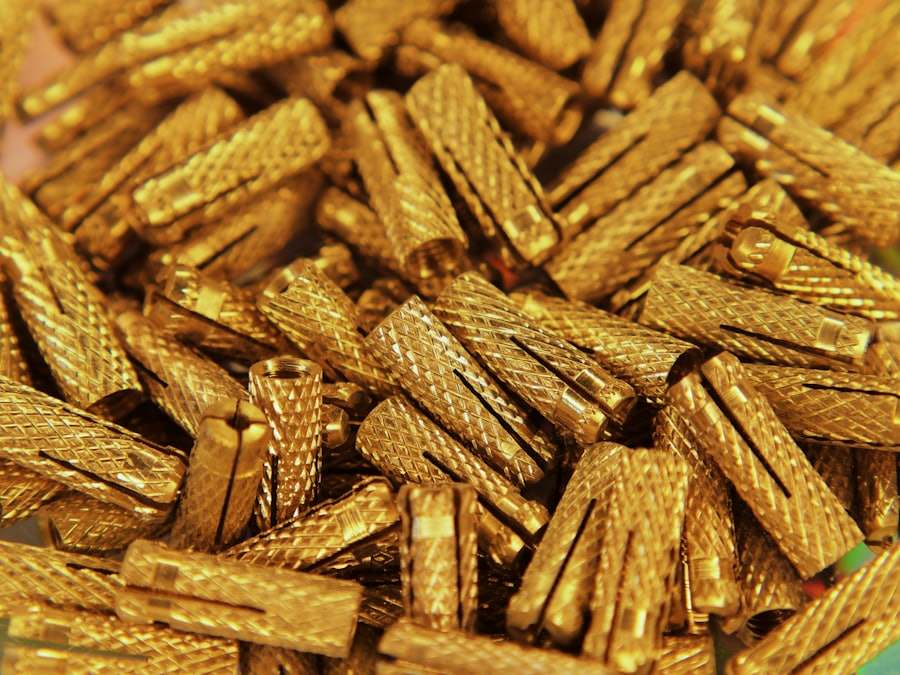
Brass is a copper-zinc alloy that machines faster than any common engineering metal, conducts electricity and heat well, resists corrosion in fresh water and indoor air, and has a colour that architects and interior designers specify for its own sake. Through CutLinq you can order brass parts by fiber laser cutting from sheet up to 6 mm, CNC turning and milling from bar and plate, and finishing by brushing, polishing or clear lacquer.
Two grades cover almost all work: CuZn37 (CW508L, similar to C27200) for sheet and forming, and CuZn39Pb3 (CW614N, C38500) for turned and milled parts. Upload a DXF or STEP file and receive a binding quote within 12 hours.
Brass grades and where to use them
CuZn37 is a single-phase alpha brass with 37% zinc. It bends, deep-draws and laser cuts well, so it is the grade for sheet parts: plates, signage letters, trims and enclosures. CuZn39Pb3 contains 3% lead, which breaks chips into short pieces and gives a machinability index of 100, the reference for all other metals. It is the standard for turned fittings but bends poorly and cracks at tight radii.
Lead-free CuZn21Si3P (EcoBrass) is required for drinking water fittings in projects that follow European or US potable water rules; it machines almost as well and costs 20-30% more. Naval brass CuZn39Sn1 and aluminium brass CuZn20Al2 are specified for seawater heat exchanger tubes on the Gulf coast.
| Grade EN (UNS) | Zinc / additions | Machinability | Best for | Forms available |
|---|---|---|---|---|
| CuZn37 (C27200) | 37% Zn | 40 | sheet parts, bending, laser cutting | sheet 0.5-6 mm |
| CuZn39Pb3 (C38500) | 39% Zn, 3% Pb | 100 | turning, milling, fittings | round bar 3-200 mm, hex 4-60 mm |
| CuZn40Pb2 (C37700) | 40% Zn, 2% Pb | 90 | forgings, hot-pressed valve bodies | forging stock |
| CuZn21Si3P (C69300) | 21% Zn, 3% Si | 80 | lead-free potable water parts | bar 6-80 mm |
| CuZn39Sn1 (C46400) | 39% Zn, 1% Sn | 30 | marine, seawater fittings | bar and plate |
Laser cutting brass sheet
Brass reflects 1 µm laser light strongly, which was a problem for CO2 lasers. Modern fiber lasers of 3 kW and above cut brass reliably up to 6 mm with nitrogen assist gas at 12-18 bar. The cut edge is bright and slightly rougher than on stainless, around Ra 6-12 µm, and the kerf is 0.15-0.25 mm.
Because brass conducts heat away from the cut, small holes below 1.5 times sheet thickness may show dross at the bottom. Keep the minimum hole at 1.5 x thickness or drill it afterwards.
| Sheet thickness | Laser power needed | Tolerance | Edge quality |
|---|---|---|---|
| 0.5 to 2 mm | 2 kW | ±0.1 mm | clean, minimal dross |
| 3 to 4 mm | 3 kW | ±0.15 mm | light dross, deburr recommended |
| 5 to 6 mm | 4 to 6 kW | ±0.2 mm | visible striations, deburr required |
| above 6 mm | waterjet | ±0.2 mm | matte edge, no heat effect |
CNC machining brass
CuZn39Pb3 runs at 150-300 m/min cutting speed with uncoated carbide and needs no coolant for most operations. Turned surfaces reach Ra 0.8 µm straight off the tool. Threads down to M2 are cut without tearing. Tolerances of ±0.02 mm on diameters and ±0.05 mm on lengths are routine.
Bar stock in hexagonal section from 4 to 60 mm across flats is available across Egypt, the UAE and Saudi Arabia, which makes hex fittings and terminals cheaper than milling a hex on round bar.
- Turning tolerance: ±0.02 mm on diameter, ±0.05 mm on length
- Surface finish as machined: Ra 0.8 µm; polished: Ra 0.1 µm
- Smallest thread: M2 external, M1.6 internal
- Smallest drilled hole: 0.5 mm, depth up to 10 x diameter
- Knurling: DIN 82 RAA and RGE patterns, pitch 0.5 to 1.6 mm
Finishing and corrosion in the MENA climate
Uncoated brass tarnishes to a brown patina within weeks in coastal humidity and faster in the Gulf where salt air is present. For decorative parts specify a finish: brushed and clear lacquered (20-30 µm), polished and lacquered, or PVD gold or bronze coating for exterior signage. Nickel plating 5-10 µm followed by chrome 0.3 µm is the standard for sanitary fittings.
Brass suffers dezincification in water above 40% zinc content or with high chloride; use CuZn37 or DZR grades for water contact, and avoid contact with bare aluminium in humid outdoor assemblies because of galvanic corrosion.
Design notes for brass parts
Brass is 8.4-8.5 g/cm3, about 8% heavier than steel, and material cost per kilogram is several times that of mild steel, so material is often the largest cost element. Design to minimise scrap: nest sheet parts tightly and specify bar diameter close to the finished size. Bend CuZn37 sheet with an inside radius of at least 1 x thickness in the half-hard temper and 0.5 x thickness in the soft temper.
Design tips
- Choose CuZn39Pb3 for anything turned or milled and CuZn37 for anything bent or laser cut; do not ask for a bent part in CuZn39Pb3.
- Minimum laser-cut hole in brass sheet: 1.5 x thickness; minimum slot width 1.5 x thickness.
- Inside bend radius for CuZn37: 1 x thickness (half-hard), bend across the rolling direction where possible.
- Use hexagonal bar for hex fittings; a 17 mm AF hex from hex bar saves 30-40% machining time over round bar.
- Specify a finish for every visible brass part: brushed and lacquered is the most durable low-cost option outdoors.
- Keep wall thickness in turned brass fittings above 1 mm; below that the part distorts in the chuck.
- Avoid direct contact between brass and aluminium in outdoor assemblies; add a nylon washer or coating.
Applications
| Industry | Example parts | Typical material |
|---|---|---|
| Plumbing and water | valve bodies, compression fittings, manifolds | CuZn39Pb3, CuZn21Si3P (lead-free) |
| Electrical | busbar connectors, terminals, cable gland bodies, earthing bosses | CuZn39Pb3, CuZn37 |
| Architecture and interiors | signage letters, handrail caps, door trims, lift panels | CuZn37 sheet 1-3 mm |
| Hospitality | table numbers, menu holders, lamp parts | CuZn37 sheet, polished |
| HVAC and refrigeration | flare fittings, sight glass bodies, nozzles | CuZn39Pb3 |
| Instrumentation | gauge bodies, pressure fittings, adapters | CuZn39Pb3, CuZn40Pb2 |
| Marine | seawater strainer parts, propeller shaft nuts | CuZn39Sn1 |
Pricing and lead time
Price of a brass part is driven mainly by material weight (brass costs roughly 4-6 times mild steel and 1.5-2 times stainless 304 per kilogram), then machining or cutting time, then quantity, because setup of 20-40 minutes for turning or nesting for laser is fixed per job. Lead-free grades add 20-30% on material. Realistic lead times are 3 to 5 working days for laser-cut brass sheet parts, 4 to 7 working days for turned or milled parts, and 7 to 12 working days with plating or lacquering.
Frequently asked questions
Fiber lasers of 3 kW and above cut brass up to 6 mm cleanly. Above 6 mm, or where a heat-free edge is required, waterjet is used.
Upload your DXF or STEP file now and receive a binding quote for brass parts within 12 hours.